Choosing how to honor a loved one's cremated remains is deeply personal. This guide compares Parting Stone — a service that transforms cremated remains into smooth, stone-like solidified pieces — with scattering ashes, including scattering at sea, scattering ceremonies, and other ways to release remains, so your family can make a calm, informed decision.
Quick Answer
Parting Stone vs scattering ashes at a glance
- Choose scattering ashes if your family wants a symbolic release in a meaningful place and is comfortable with the finality of scattering.
- Consider Parting Stone if your family wants cremated remains transformed into touchable, shareable stone-like pieces the family can keep, hold, share, or display.
- Scattering may be deeply meaningful, but local rules and permissions can vary by location, property, waterway, park, or cemetery.
- Parting Stone may fit better when several relatives want physical keepsakes, or the family does not want the finality of scattering.
- Some families choose both — scatter a portion in a meaningful place and keep the rest as stones, in an urn, or as jewelry.
- Neither option is always better. The right choice depends on the loved one's wishes, family agreement, budget, beliefs, comfort level, location, and timing.
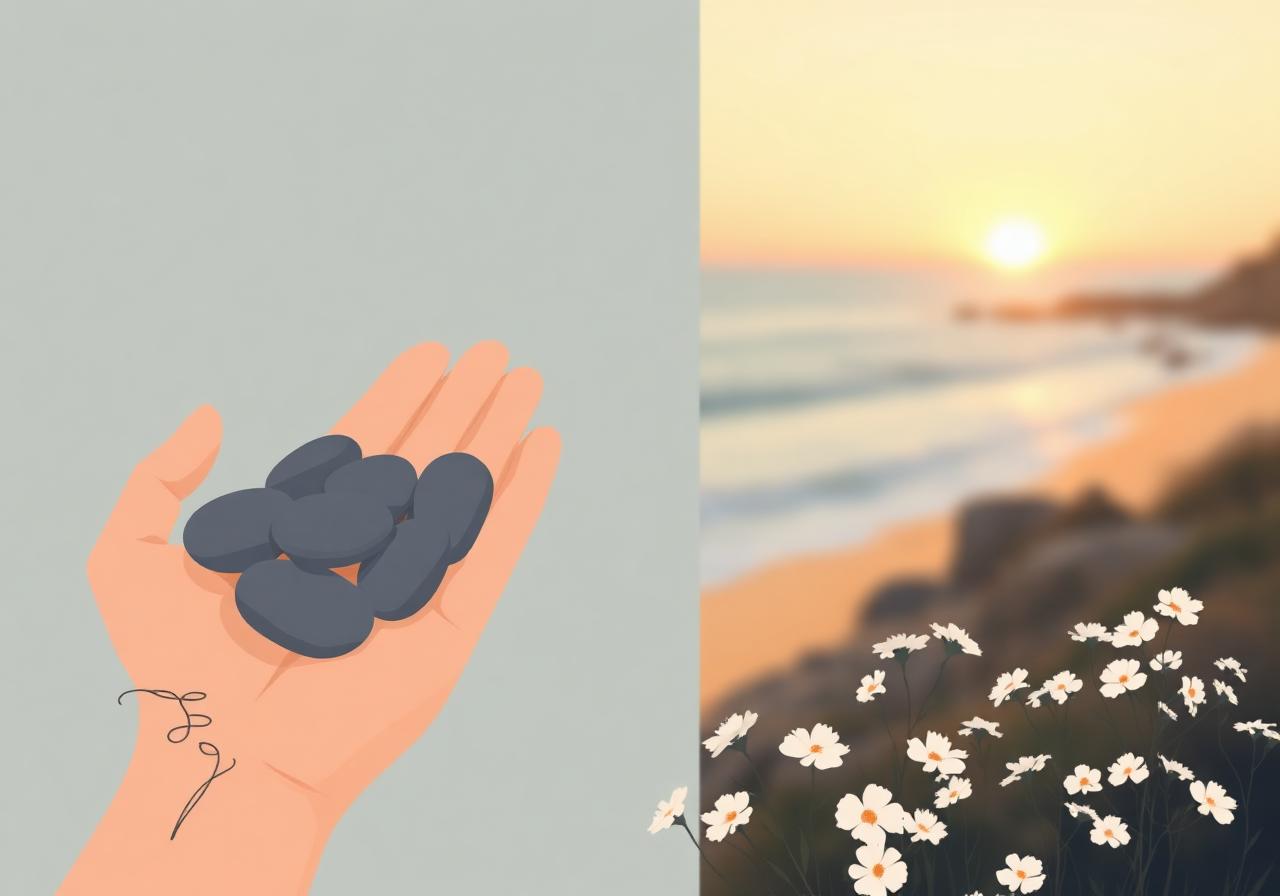
Example visual of cremation stones beside a peaceful scattering setting. Final appearance and locations vary.
Keep vs Release: Quick Decision Guide
A short decision table to help your family see — at a glance — which direction may fit best. Cost levels are broad; rules and permissions vary by location.
| Family situation | Better fit | Why | What to consider |
|---|---|---|---|
| Family wants a symbolic release | Scattering ashes | A scattering ceremony often carries a strong sense of release, return, and farewell. | Confirm the location is allowed and check any required permissions. |
| Family wants a physical keepsake | Parting Stone, urn, jewelry, or keepsake urns | Each option keeps something tangible the family can hold or display. | Decide who keeps each item long term. |
| Several relatives want something to keep | Parting Stone or keepsake urns | Both produce multiple pieces that can be divided among relatives. | Stones are touchable and solid; keepsake urns hold a small portion of loose ashes. |
| Family wants the lowest-cost option | Simple scattering or a basic urn | Both can be among the lowest typical out-of-pocket options. | Verify scattering location is allowed; confirm urn material and seal. |
| Family wants a ceremony at sea | Scattering at sea | Meaningful for ocean, military, fishing, or coastal memories. | Confirm boat services, distance rules, weather, and any permits. |
| Family wants something to hold or display later | Parting Stone, urn, or keepsake urns | All keep remains with the family in a form that can be revisited over time. | Pick the format that fits how the family wants to remember day to day. |
| Family is not ready to decide | Keep ashes safely while deciding | There is usually no rush to make a final placement. | Revisit options together when the family feels ready. |
| Family disagrees about what to do | Combine: scatter some + keep some | Different relatives can each choose a keepsake that fits. | Talk through wishes before finalizing anything irreversible. |
Ad · Affiliate
If scattering feels too final, compare Parting Stone
Parting Stone may be worth comparing as a touchable, shareable alternative when your family wants to keep cremated remains rather than release them. Review current process, pricing, and timeline directly before deciding.
See How Parting Stone WorksWhat This Guide Covers
- Keep vs release: quick decision guide
- Parting Stone vs scattering ashes: the main difference
- Quick comparison table
- What is Parting Stone?
- What does scattering ashes mean?
- When scattering ashes may be the better choice
- When Parting Stone may be the better choice
- Parting Stone vs scattering ashes cost
- Scattering ashes at sea vs Parting Stone
- What to say when scattering ashes
- Scattering ceremony vs Parting Stone memorial
- Can families choose both?
- What if scattering feels too final?
- Legal and permission cautions before scattering ashes
- Faith, culture, and family considerations
- What to do with the urn after scattering ashes
- Parting Stone vs scattering ashes vs urns
- Best choice by family situation
- Questions to ask before choosing
- What if your family disagrees?
- Final verdict
- FAQ
Parting Stone vs Scattering Ashes: The Main Difference
Scattering ashes releases cremated remains in a meaningful place — often felt as a symbolic, emotional, and final act of farewell.
Parting Stone transforms cremated remains into smooth, stone-like pieces called solidified remains, also known as cremation stones. Instead of releasing the remains, the family receives a set of pieces they can hold, share, and display.
Scattering tends to feel symbolic and final. Parting Stone tends to feel tangible and shareable. Both can be meaningful — and many families choose both: scattering some ashes in a meaningful place and keeping the rest as stones, in a small urn, or as jewelry. For background, see how providers turn ashes into stones and our overview of what to do with ashes after cremation.
Quick Comparison Table
How Parting Stone compares with scattering and other common memorial options. Cost levels are broad and may vary — confirm current pricing directly with each provider, and confirm any rules or permissions before scattering.
| Option | Best for | Keeps a physical memorial? | Shareable? | Cost level | Rules to check? | Main drawback | Related guide |
|---|---|---|---|---|---|---|---|
| Parting Stone / solidified remains | Touchable, shareable family keepsakes | Yes — set of stones | Yes — multiple pieces | Premium | Confirm process & shipping | Higher cost; appearance varies | Parting Stone review |
| Scattering ashes | Symbolic release at a meaningful place | No (released) | No (released) | Low–Moderate | Yes — varies by location | Final; rules and permissions vary | Ashes guide |
| Scattering ashes at sea | Coastal, military, or boating memories | No (released) | No (released) | Moderate–High | Yes — distance and permits | Travel/boat costs; weather dependent | Ashes guide |
| Traditional urn | One familiar central memorial | Yes — single container | Limited | Low–Moderate | Cemetery/niche rules if placed | Not easily divided; remains are loose | Urns guide |
| Keepsake urns | Dividing portions among relatives | Yes — one per relative | Yes — per urn | Low–Moderate | Confirm sealing & material | Each holds only a small portion of loose ashes | Keepsake urns |
| Cremation jewelry | Wearable personal keepsake | Yes — wearable piece | Yes — per piece | Low–High | Confirm material & care | Holds only a tiny amount of ashes | Cremation jewelry |
| Memory box / photo memorial | Non-ash remembrance | Yes — non-ash items | Yes (DIY) | Low | None typical | Not a remains-based format | Ashes guide |
| Cemetery burial / columbarium niche | Permanent dedicated place | Yes — at cemetery | Limited | Moderate–Very high | Cemetery & niche rules | Travel to visit; ongoing rules | Urns guide |
What Is Parting Stone?
Parting Stone is one well-known provider of solidified remains. Solidified remains are cremated remains transformed into smooth, stone-like memorial pieces. Families may keep, share, display, or use them as part of a broader memorial decision, depending on their wishes and the provider's guidance.
For more context, see our Parting Stone review, our Parting Stone cost guide, our balanced look at whether Parting Stone is worth it, our notes on whether Parting Stone is legit, and a summary of Parting Stone complaints.
What Does Scattering Ashes Mean?
Scattering ashes — sometimes called spreading ashes — means releasing cremated remains in a chosen location. Common settings include:
- At sea or in the ocean.
- In a garden at home, with the property owner's permission.
- On private land with the owner's clear permission.
- In a designated scattering garden, often at a cemetery or memorial park.
- On certain public land or waterways where allowed.
- Other meaningful locations the loved one cared about.
Rules can vary by location, property owner, cemetery, park, waterway, airline, country, and local authority. Always check what is allowed for your specific location before planning a scattering. We do not provide legal advice — when in doubt, ask a funeral director.
When Scattering Ashes May Be the Better Choice
The loved one requested scattering
Honoring a stated wish often guides the family to scattering as the right choice.
The family wants a symbolic release
Scattering can carry a sense of release, freedom, and return to a meaningful place.
There is a meaningful location where scattering is allowed
A garden, family land with permission, the ocean, or a scattering garden where rules permit.
The family does not want to keep ashes at home
Some families prefer not to keep cremated remains in the home long term.
The family wants a lower-cost option
Simple scattering in an allowed location can be one of the lowest-cost memorials.
The family wants a ceremony outdoors or at sea
Scattering ceremonies often take place outdoors and can include a brief, personal moment.
Family members agree with the decision
Because scattering is final, broad family agreement matters more here than with keepsake options.
When Parting Stone May Be the Better Choice
Several family members want keepsakes
Parting Stone returns a set of solid pieces that can be divided among relatives.
The family is uncomfortable with loose ashes
Solid stone-like pieces may feel easier to hold than loose cremated remains.
The family does not want the finality of scattering
Stones stay with the family and can be revisited, displayed, or moved over time.
The family wants something touchable and shareable
Stones can be passed hand to hand and divided among relatives without handling loose ashes.
The family wants a modern alternative to an urn
Solidified remains shift away from a single container toward distributed memorials.
The family has kept ashes at home and wants another option
Many families choose Parting Stone after months or years of keeping an urn.
The family is comfortable with the cost and timeline
After confirming current pricing, process, and shipping directly with the provider.
Parting Stone vs Scattering Ashes Cost
Cost varies widely on both sides — the ceremony, location, and provider all matter.
- Simple scattering in a place that is allowed can be one of the lowest-cost memorial options.
- Scattering at sea, boat services, permits, travel, ceremony costs, scattering tubes, or biodegradable urns can add cost.
- Parting Stone is usually a premium memorial option compared with simple scattering, but it returns a full set of shareable pieces the family can keep.
- Cost should be weighed against what the family wants — symbolic release, physical keepsakes, family sharing, ceremony, or long-term display.
- If multiple relatives want their own keepsake afterward, the comparison shifts: scattering plus several keepsake items vs a single Parting Stone set may be closer in total than a one-to-one comparison.
For structured pricing breakdowns, see our Parting Stone cost guide, our broader cremation stones cost overview, and our balanced look at whether Parting Stone is worth it. Confirm current Parting Stone pricing, packages, shipping, and timeline directly with the provider — and confirm any scattering-related costs, rules, and permissions before planning a ceremony.
Ad · Affiliate
Check current Parting Stone pricing
Pricing, packages, and timelines change. Confirm the latest details directly before comparing with scattering ashes.
Check Current Parting Stone PricingScattering Ashes at Sea vs Parting Stone
- Scattering at sea can be deeply meaningful for families connected to the ocean, military service, fishing, boating, or coastal memories.
- It may involve boat services, distance requirements, permits, or specific guidance depending on location.
- Parting Stone may be better if family members want something physical to keep after the ceremony.
- Some families combine both — scatter a portion at sea, keep the rest as stones, in jewelry, or in a small urn.
- We do not give legal advice. Check local, state, federal, and service-provider rules before scattering at sea.
What to Say When Scattering Ashes
There is no required script. Many families speak briefly, share a memory, or simply stand together. Gentle starting points — pick one or two:
- A short personal memory — one moment that captures who they were.
- A thank-you — for what they meant or what they taught you.
- A short goodbye — a few honest words spoken to the loved one.
- A moment of silence shared together.
- A prayer if appropriate for your family or faith tradition.
- A family-chosen reading — a passage your family agrees feels right.
- A few words from the loved one's own life or values — a saying, lesson, or phrase they often used.
- For broader inspiration, see our funeral poems and readings.
It is okay if no one knows exactly what to say. Presence often matters more than the words. Avoid copying long copyrighted poems or song lyrics without permission.
Scattering Ceremony vs Parting Stone Memorial
- A scattering ceremony is often a single, in-person moment of release in a meaningful place.
- A Parting Stone memorial tends to be a longer-term home memorial, with stones held, displayed, or shared among relatives over time.
- Some families combine the two: scatter some ashes at the ceremony and keep the rest as stones, jewelry, or a keepsake urn for the wider family.
- Neither approach replaces the other — they can sit side by side in a family's grief and remembrance.
Can Families Choose Both?
Yes. Many families do not need to choose only one option. There is no rule that says everyone has to agree on a single memorial.
- Some families scatter a portion in a meaningful place and keep the rest as stones, in an urn, in jewelry, or in a keepsake urn.
- Different relatives may keep different keepsake types — one wears jewelry, another keeps a small urn, another holds a few stones.
- Family agreement matters, especially when ashes will be divided.
- The loved one's wishes, culture, faith, and each person's comfort level should guide the decision.
For broader options, see our small urns for ashes guide, our keepsake urns for ashes guide, and our cremation jewelry for ashes guide.
What If Scattering Feels Too Final?
It is common to feel drawn to scattering and also unsure because it is irreversible. A few gentle reminders:
- It is okay to wait. There is usually no deadline.
- Many families keep ashes safely at home while deciding what feels right.
- Consider a memorial ceremony without scattering yet — gather, share memories, and revisit the placement decision later.
- You can keep some ashes and scatter some later, when the family feels ready.
- Compare urns, keepsake urns, cremation jewelry, cremation stones, cemetery burial, and memory boxes before deciding.
For balanced alternatives, see our Parting Stone alternatives guide and our overview of urns for cremation ashes.
Ad · Affiliate
If scattering feels too final, Parting Stone may be worth comparing
Parting Stone is a touchable, shareable alternative that keeps cremated remains with the family as smooth, stone-like pieces. Confirm current process, pricing, timeline, shipping, and eligibility directly before deciding.
See How Parting Stone WorksLegal and Permission Cautions Before Scattering Ashes
Important — Not Legal Advice
Rules vary widely. The list below is a general checklist of things families often need to verify — not legal guidance. Always confirm what applies to your specific location and situation before scattering, and ask a licensed funeral director if you are unsure.
- Private property — get clear permission from the property owner.
- Cemetery or memorial-park scattering gardens — confirm rules, permits, and any fees.
- Public parks, beaches, or trails — check local, state, and federal land rules.
- Waterways, lakes, rivers, and the ocean — confirm any distance, container, or notification requirements.
- Travel and airlines — confirm rules for transporting cremated remains, container type, and required documentation.
- Local, state, federal, or country-specific guidance — laws vary widely by jurisdiction.
- If anything is unclear — ask a funeral director or the relevant authority before the ceremony.
Faith, Culture, and Family Considerations
Some faiths and cultures have specific views about cremation, keeping ashes, and scattering. Common questions families search for include what does the bible say about scattering ashes, and similar questions in other traditions. Answers vary by denomination, faith, and family teaching.
- Consider the loved one's wishes, family traditions, and any religious guidance they would have wanted honored.
- If unsure, speak with a trusted faith leader, funeral director, or family elder.
- This guide does not provide religious advice — it points to options so your family can make the right call together.
What to Do With the Urn After Scattering Ashes
After scattering, families have several gentle options for the urn itself:
- Keep it as a memorial container on a shelf, mantle, or in a quiet corner of the home.
- Repurpose it as a keepsake holder for letters, photos, or small mementos.
- Place it inside a memory box alongside other meaningful items.
- Return it to the funeral home if appropriate, and ask what they recommend locally.
- Plan ahead with a biodegradable or scattering container designed for the ceremony itself, if you know in advance.
- If unsure, ask the funeral home or crematory what is appropriate in your area.
Parting Stone vs Scattering Ashes vs Urns
A wider comparison across the most common memorial options.
| Option | Best for | Physical keepsake? | Finality level | Shareable? | Cost level | Main concern | Related guide |
|---|---|---|---|---|---|---|---|
| Parting Stone | Shareable stone-like keepsakes | Yes | Low — kept by family | Yes — multiple pieces | Premium | Higher cost; appearance varies | Parting Stone review |
| Scattering ashes | Symbolic release | No | High — released | No (released) | Low–Moderate | Rules and permissions vary by location | Ashes guide |
| Traditional urn | One central memorial | Yes | Low–Moderate | Limited | Low–Moderate | Not easily divided | Urns guide |
| Keepsake urns | Dividing portions | Yes (per urn) | Low–Moderate | Yes — per urn | Low–Moderate | Holds loose ashes | Keepsake urns |
| Cremation jewelry | Wearable keepsake | Yes (wearable) | Low | Yes — per piece | Low–High | Holds only a tiny amount | Cremation jewelry |
| Cemetery burial | Permanent dedicated place | Yes (at cemetery) | High — placed | Limited | Moderate–Very high | Travel to visit; cemetery rules | Urns guide |
| Memory box / photo memorial | Non-ash remembrance | Yes (non-ash) | Low | Yes (DIY) | Low | Not a remains-based format | Ashes guide |
Best Choice by Family Situation
| Family situation | Best option | Why it may fit | What to consider | Related guide |
|---|---|---|---|---|
| Loved one requested scattering | Scattering ashes | Honors a stated wish to be released in a meaningful place. | Confirm location is allowed and check any required permissions. | Ashes guide |
| Family wants a physical keepsake | Parting Stone, urn, or jewelry | Each keeps something tangible the family can hold or display. | Decide who keeps each item long term. | Parting Stone review |
| Several relatives want keepsakes | Parting Stone or keepsake urns | Both let multiple people each keep something meaningful. | Stones are touchable and solid; keepsake urns are lower cost per piece. | Keepsake urns |
| Family wants lowest cost | Simple scattering or basic urn | Lowest typical out-of-pocket options when done simply. | Verify scattering location is allowed; confirm urn material and seal. | Cost overview |
| Family wants a ceremony at sea | Scattering at sea | Meaningful for coastal, military, fishing, or boating memories. | Confirm boat services, distance rules, weather, and any permits. | Ashes guide |
| Family feels scattering is too final | Parting Stone, urn, or keepsake urns | All three keep remains with the family rather than releasing them. | There is usually no rush — keeping ashes at home while deciding is common. | Memorial alternatives |
| Family wants wearable remembrance | Cremation jewelry | Worn close to the body as a private daily keepsake. | Confirm material, durability, and ash amount needed. | Cremation jewelry |
| Family wants one central memorial | Traditional urn | A single familiar container holds the remains together. | Confirm size, material, and any cemetery or niche rules. | Urns guide |
| Family is not ready to decide | Keep at home in temporary container | There is usually no rush to make a final placement. | Revisit options together when the family feels ready. | Ashes guide |
| Family disagrees about ashes | Combine: scatter some + keep some | Different relatives can each choose a keepsake that fits. | Talk through wishes before finalizing anything irreversible. | Memorial alternatives |
Questions to Ask Before Choosing
- What did the loved one want?
- Does the family want to keep, scatter, divide, bury, or transform the ashes?
- Does scattering feel comforting or too final?
- Is there a meaningful location where scattering is allowed?
- Do local, state, federal, cemetery, park, or waterway rules apply?
- How many relatives want keepsakes?
- Is the family comfortable with loose ashes?
- Is the family comfortable with solidified remains?
- What is the budget?
- Is timeline important?
- Are there religious, cultural, or family preferences to honor?
- Has everyone agreed before a final decision?
Alternatives to Scattering Ashes and to Parting Stone
If neither feels exactly right, there are many other options. Most families find their best answer by combining a couple of these.
Parting Stone / solidified remains
Cremated remains transformed into smooth, stone-like pieces. · Learn more
Traditional urn
A single container that holds all of the cremated remains. · Learn more
Keepsake urns
Small urns that hold portions of ashes for multiple relatives. · Learn more
Small urns
Compact containers for shelf, mantle, or travel display. · Learn more
Cremation jewelry
Wearable urn necklaces, pendants, rings, bracelets, or charms. · Learn more
Cemetery burial
Burying an urn in a cemetery plot.
Columbarium niche
A niche space designed for urn placement.
Memorial garden
A private garden spot for placement, planting, or scattering where allowed.
Memory box
A non-ash keepsake box of letters, photos, and meaningful items.
Keep ashes safely at home while deciding
There is usually no rush to choose a final placement. · Learn more
For a deeper side-by-side, see our full Parting Stone alternatives guide, our roundup of what to do with ashes after cremation, and related comparisons: Parting Stone vs urn and Parting Stone vs cremation jewelry.
What If Your Family Disagrees?
It is common for families to feel pulled in different directions about what to do with ashes. A few practical steps can help:
- Pause if you can — there is usually no rush.
- Review the loved one's wishes, written or spoken.
- Consider dividing the ashes so different relatives can each choose a different keepsake type.
- One person may want to scatter while another prefers jewelry, an urn, or cremation stones. Combining can honor everyone.
- Ask a funeral director, clergy member, or trusted family elder for help if needed.
- Avoid rushing a choice that feels final.
Final Verdict
Scattering ashes may be the right choice if your family wants a symbolic release and has a meaningful location where scattering is allowed. Parting Stone may be worth comparing if your family wants touchable, shareable solidified remains instead of releasing all of the ashes. The best choice depends on the loved one's wishes, family agreement, budget, beliefs, location, comfort level, and whether the family wants a physical keepsake — and many families find their answer by combining two options rather than picking just one.
Ad · Affiliate
If your family is comparing Parting Stone with scattering ashes
Review the current process, pricing, timeline, and alternatives directly before deciding.
See How Parting Stone Works