Choosing urns for cremation ashes is one of the most personal decisions a family makes after a loved one is cremated. This guide explains the most common urn types, what size to choose, what to consider before buying, and how urns compare with keepsake urns, jewelry, scattering, and cremation stones — so you can decide calmly, at your own pace.
Quick Answer
What are urns for cremation ashes?
Urns for cremation ashes are containers designed to hold cremated remains. Common options include full-size adult urns, keepsake urns, mini urns, burial urns, biodegradable urns, scattering urns, decorative urns, and personalized urns.
- The right urn depends on whether the family wants to keep, bury, scatter, divide, display, or travel with the ashes.
- A full-size urn typically holds most or all of an adult's remains; keepsake urns hold a small portion.
Families who do not want a traditional urn can also compare cremation stones, cremation jewelry, scattering, burial, or memory boxes.
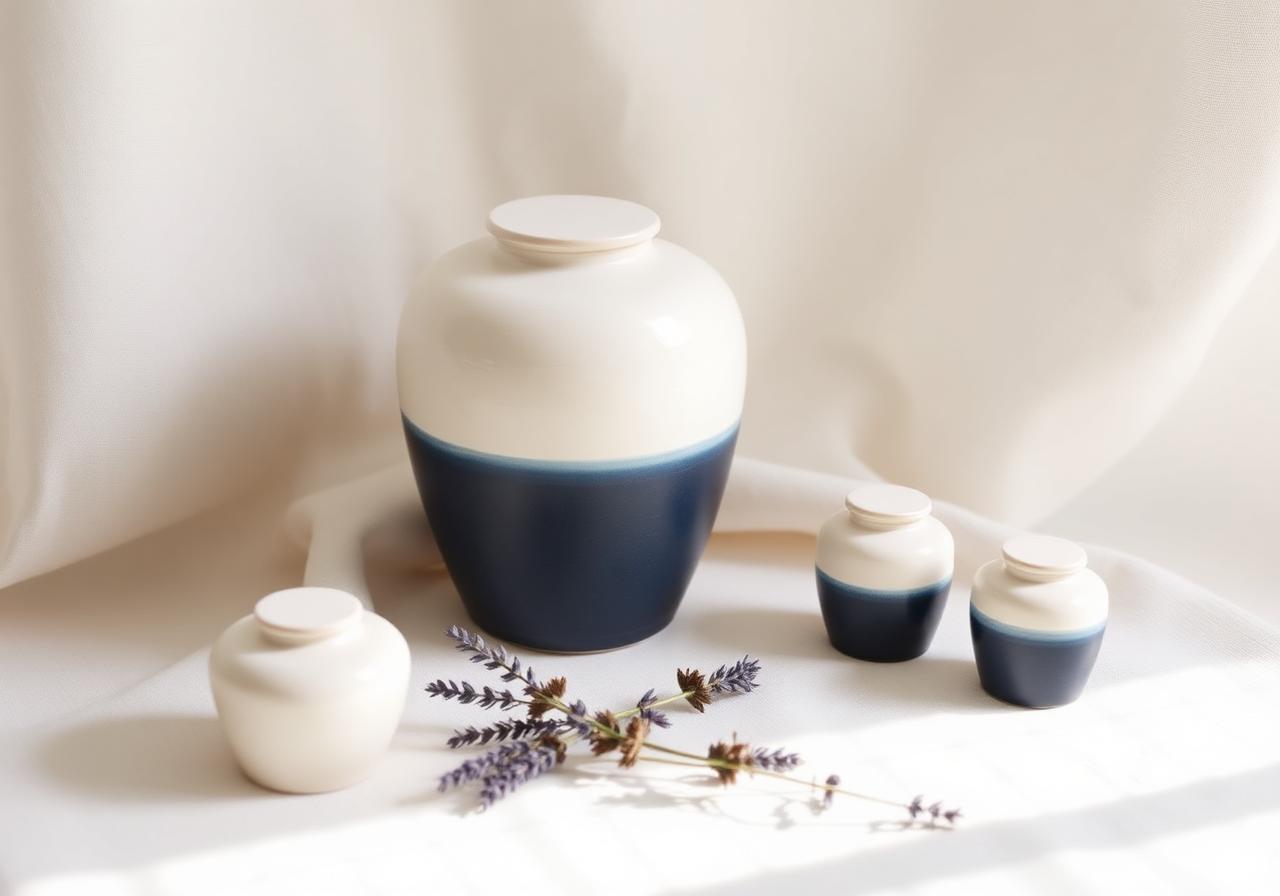
A full-size urn paired with smaller keepsake urns is one common way families honor a loved one together.
What This Guide Covers
- What are urns for cremation ashes?
- Types of urns for cremation ashes
- Best urn type by situation
- What size urn do you need?
- Urns for human ashes vs keepsake urns
- Urns vs cremation stones
- Urns vs jewelry, scattering, burial and more
- How much do urns for ashes cost?
- Where to buy urns for ashes
- What to avoid before buying an urn
- Urns for ashes for adults
- Small urns and mini urns for ashes
- Keepsake urns for ashes
- Burial urns and biodegradable urns
- Questions to ask before choosing
- Final verdict
- FAQ
What Are Urns for Cremation Ashes?
Urns for cremation ashes — also searched as urns for ashes, urn for ashes, urns for human ashes, cremation urns, and urns for cremated remains — are containers made to hold cremated remains.
An urn may be:
- Kept at home as a quiet daily memorial.
- Placed in a columbarium niche.
- Buried in a cemetery plot or family grave.
- Used for a scattering ceremony.
- Divided into smaller keepsake urns so several relatives can each hold a portion.
Urns are not the only option. For the broader picture, see what to do with ashes after cremation.
Types of Urns for Cremation Ashes
A calm overview of the most common forms families consider. None is universally best — the right one fits the wearer's wishes and the family's plan.
Full-size adult urns
Best for
Holding most or all of an adult's cremated remains in one main urn
Often searched as urns for ashes for adults, adult cremation urns, or full size urns for human ashes. The most familiar choice for a single central memorial.
What to consider
Material, size, and where the urn will live (home, niche, or burial).
Main drawback
Larger size means less flexibility if family later wants to share portions.
Keepsake urns
Best for
Letting several family members each hold a small portion
Often called keepsake urns for ashes or keepsake urns for human ashes. Useful when relatives want a personal share without the full urn at every home.
What to consider
How many keepsakes the family needs, and how each will be displayed.
Main drawback
Each keepsake holds only a small portion — most ashes still need a home.
Small urns and mini urns
Best for
Small portions, shared family keepsakes, or a small display piece
Includes small urns for ashes, small urns for human ashes, and mini urns for ashes. Often chosen alongside a main urn rather than instead of one.
What to consider
Whether it pairs with a main urn, jewelry, or a memory box.
Main drawback
Easy to misplace; not suitable for all of an adult's remains.
Burial urns
Best for
Cemetery burial in a plot or grave-side placement
Burial urns are designed for in-ground placement. Always confirm the cemetery's specific rules and any required vault before buying.
What to consider
Cemetery rules, urn vault requirements, and material durability.
Main drawback
Some cemeteries require a separate vault, which can add cost.
Biodegradable urns
Best for
Green burial, water placement, or natural-return memorials where allowed
Biodegradable urns are made to break down naturally. Confirm scattering or burial permits and any cemetery, park, or waterway rules before choosing one.
What to consider
Material (paper, salt, sand, plant fiber), permits, and local rules.
Main drawback
Not appropriate everywhere — water and land rules vary widely.
Custom or personalized urns
Best for
Engraving, names, dates, photos, symbols, or a design that reflects the loved one
Often searched as custom urns for ashes or personalized urns for human ashes. A meaningful option when the family wants the urn to reflect personality, faith, or interests.
What to consider
Lead time for engraving, sample work, and proof approval before production.
Main drawback
Custom orders are usually non-refundable once produced.
Decorative urns
Best for
Quiet display in the home
A wide style range, from minimalist to traditional. Many decorative urns are display-first; confirm with the seller if you may later need it for burial or niche placement.
What to consider
Material — wood, metal, ceramic, marble, stone, glass — and how it fits the room.
Main drawback
Not always rated for burial; check before any cemetery use.
Scattering urns
Best for
Families planning a scattering ceremony
Scattering urns are designed to release ashes cleanly. Always confirm local rules and permissions before scattering on land or water.
What to consider
Local laws, land/water permissions, and weather conditions on the day.
Main drawback
Once ashes are scattered, the decision is permanent.
Best Urn Type by Situation
A quick way to narrow the choice. Find the situation closest to yours.
If…
Want one central memorial
ConsiderFull-size adult urn
If…
Want each family member to have a small portion
ConsiderKeepsake urns or mini urns
If…
Want cemetery burial
ConsiderBurial urn (confirm vault and plot rules)
If…
Want eco-conscious placement where allowed
ConsiderBiodegradable urn
If…
Want home display
ConsiderDecorative urn (wood, ceramic, metal, marble, glass)
If…
Want personalization
ConsiderCustom or engraved urn
If…
Want to scatter ashes
ConsiderScattering urn (confirm local rules)
If…
Want something other than loose ashes in an urn
ConsiderCremation stones, jewelry, or a memory box
If…
Not ready to decide
ConsiderKeep ashes safely in the temporary container until ready
What Size Urn Do You Need?
Urn size depends on the amount of cremated remains and how the urn will be used. The table below is a general guide — always confirm exact sizing with the funeral home, crematory, cemetery, columbarium, or urn seller before buying.
| Urn type | Typical use | What to confirm |
|---|---|---|
| Full-size adult urn | Most or all of an adult's cremated remains | Interior capacity vs the amount returned by the crematory |
| Keepsake urn | A small portion for one family member | How many keepsakes are needed and how each will be displayed |
| Mini urn | Very small portion or shared keepsake | Whether it pairs with a main urn, jewelry, or memory box |
| Companion urn | Two people kept together (e.g. spouses) | Combined capacity and whether the design separates remains |
| Niche urn | Placement in a cemetery or columbarium niche | Exact niche interior dimensions and any material rules |
| Burial urn | In-ground cemetery burial | Cemetery rules and whether an urn vault is required |
| Biodegradable urn | Green burial or natural placement where allowed | Local rules, permits, and the cemetery's policy |
| Scattering urn | Scattering ceremony on land or water | Local laws, weather, and any required permissions |
Sizes vary by manufacturer. Confirm interior capacity, niche dimensions, and cemetery rules in writing before placing an order.
Sizing Checklist
- Are you keeping all ashes in one urn?
- Are you dividing ashes among family members?
- Will the urn be buried in a cemetery plot?
- Will it go in a columbarium niche?
- Will it be displayed at home?
- Do you need multiple small urns or keepsakes?
- Does the cemetery, niche, or columbarium have size rules?
Urns for Human Ashes vs Keepsake Urns
A full-size urn is generally chosen when the family wants one main container for most or all of an adult's cremated remains. A keepsake urn is much smaller — designed for a small portion that an individual relative can keep at home or display privately.
Many families combine both: one main urn for the central memorial plus several keepsakes for relatives who want their own personal share. For broader options, see what to do with ashes after cremation and our cremation jewelry for ashes guide.
Urns for Cremation Ashes vs Cremation Stones
Urns and cremation stones serve different but related needs:
- Urns hold cremated ashes in a container. Best when families want a familiar, traditional central memorial — at home, in a niche, or buried.
- Cremation stones (also called solidified remains) transform ashes into smooth, touchable stone-like pieces. Best when several relatives want a tactile, shareable alternative to loose ashes.
- Neither is universally better. The right choice depends on budget, comfort, family sharing, tradition, and the loved one's wishes — and many families combine both.
For a deeper look, see our cremation stones explainer, the turn ashes into stones guide, our Parting Stone review, the Parting Stone cost breakdown, and our Parting Stone alternatives comparison.
Ad · Affiliate
Cremation stones may be worth comparing if your family wants a touchable, shareable alternative to keeping ashes in a traditional urn. Parting Stone walks through their process and current pricing — there is no pressure to decide today.
See How Parting Stone WorksUrns vs Jewelry, Scattering, Burial and Memory Boxes
A side-by-side comparison of the most common memorial paths families weigh.
| Option | Best for | Uses all or a portion? | Shareable? | Cost level | Permanent place to visit? | Main drawback |
|---|---|---|---|---|---|---|
| Traditional urn | One central memorial at home or in a niche | All remains | No (single container) | Low–moderate | Yes (where placed) | Stays in one place |
| Keepsake urn | Sharing a small portion among relatives | Small portion | Yes (multiple) | Low | Optional | Holds only a portion |
| Cremation jewelry | Wearable, personal keepsake | Small portion | Yes (multiple pieces) | Low–premium | No | Small piece can be lost |
| Cremation stones | Touchable, shareable alternative to loose ashes | Larger portion | Yes | Premium | Optional (display) | Higher upfront cost |
| Scattering ashes | Symbolic release in a meaningful place | All or part | — | Low | Symbolic only | Permanent; rules vary |
| Burial urn | Cemetery burial in a plot or grave | All remains | No | Moderate | Yes | May require a vault |
| Biodegradable urn | Green burial or natural placement where allowed | All or part | Optional | Low–moderate | Sometimes | Permits and rules vary |
| Memory box / photo memorial | Photos, letters, small items | Optional | Yes | Low | At home | Less of a focal memorial |
Cost levels are relative ranges. Always confirm current pricing with the seller, cemetery, or funeral home.
How Much Do Urns for Ashes Cost?
Pricing varies widely. The biggest factors are:
- Material — wood, metal, ceramic, marble, glass, stone, or biodegradable composites.
- Size — full-size adult urns generally cost more than small or mini urns.
- Personalization — engraving, photos, custom artwork, and bespoke commissions add cost.
- Craftsmanship and brand — handmade or artisan urns price higher than mass-produced ones.
- Purpose — burial-rated, niche-rated, scattering, and keepsake urns serve different needs.
- Shipping and turnaround — rush options or international shipping may cost more.
We do not publish exact prices because they change often. Always compare pricing, materials, reviews, shipping, and return policy with the seller before placing an order. For broader cost context, see our cremation vs burial costs guide and the cremation vs burial calculator.
Where to Buy Urns for Ashes
Families generally compare several sources:
- Funeral homes — often offer a curated selection and can advise on cemetery rules.
- Crematories — sometimes sell directly, especially for basic and burial-rated urns.
- Online urn stores — broad catalogs with many price points and styles.
- Memorial product shops — specialized brands focused on keepsakes and custom design.
- Local monument or memorial providers — useful when matching a niche, plot, or marker.
- Cemetery-approved providers — required by some cemeteries for burial or niche placement.
Buyer Checklist
- Right size for the amount of ashes and intended use.
- Material that fits the purpose (display, burial, niche, scattering, keepsake).
- Personalization options — engraving, fonts, photo plates.
- Whether the urn opens and closes securely.
- Cemetery, niche, or columbarium size and material rules (if applicable).
- Shipping time and tracking.
- Return policy and warranty.
- Whether multiple family members will need keepsakes.
- Reviews and reputation of the seller.
What to Avoid Before Buying an Urn
A few common mistakes worth side-stepping before placing an order.
- Do not buy before confirming the size needed for the amount of cremated remains.
- Do not assume all urns are suitable for burial — many decorative urns are display-only.
- Do not assume an urn will fit a cemetery niche; always confirm interior dimensions.
- Do not ignore the loved one's wishes or family agreement.
- Do not rush the decision if relatives disagree.
- Do not forget keepsake urns if multiple people want a portion.
- Do not choose only by appearance without checking material and intended purpose.
- Do not ignore return policy and shipping timing — especially before a planned service.
Urns for Ashes for Adults
Urns for ashes for adults — also searched as adult cremation urns or full size urns for human ashes — are sized to hold most or all of an adult's cremated remains in one container.
Many families choose one full-size adult urn as the central memorial, then add smaller keepsake urns for relatives who want a personal share. Material, display location, and any cemetery requirements should guide the choice. If you want to compare adult urns with other paths, see our cremation jewelry guide and what to do with ashes after cremation.
Small Urns and Mini Urns for Ashes
Small and mini urns hold only a small portion of cremated remains. They are useful when ashes are divided among relatives, paired with a main urn, or used alongside cremation jewelry or a memory box.
Because they are small, they are easier to display discreetly — but they are not designed to hold an entire adult's cremated remains. Many families buy several together so each relative has a matching keepsake.
Keepsake Urns for Ashes
Keepsake urns for ashes (sometimes called keepsake urns for human ashes) help several family members keep a small personal portion of a loved one's cremated remains.
Keepsake urns pair naturally with one full-size urn. Families often also compare keepsake urns with cremation jewelry for ashes and cremation stones when deciding how to share remembrance among relatives.
Burial Urns and Biodegradable Urns
Burial urns are designed for in-ground placement at a cemetery. Some cemeteries require an urn vault to protect the urn underground; rules vary, so always confirm the cemetery's specific policy before buying.
Biodegradable urns are made from materials like paper, salt, sand, or plant fibers and are intended to break down naturally. They may suit families interested in a green or natural-return memorial, including water placement where allowed. Local rules, cemetery policies, and waterway permits vary widely — confirm before choosing one.
For broader context, see our cremation vs burial costs guide and the green burial guide.
Questions to Ask Before Choosing an Urn
- Will the urn hold all the ashes or only a portion?
- Is it for home display, burial, niche placement, scattering, or sharing?
- What size is needed for the amount of cremated remains?
- Does the cemetery or columbarium have specific size or material rules?
- Do multiple family members want their own keepsakes?
- What material feels right — wood, ceramic, metal, marble, glass, biodegradable?
- Is personalization important (engraving, photo, symbol)?
- What is the budget?
- Is the family comfortable keeping ashes at home?
- Would cremation stones, jewelry, scattering, or burial fit better?
- What did the loved one want?
Final Verdict
Urns for cremation ashes remain one of the most common and familiar memorial options. A full-size urn may work well for one central memorial, while keepsake urns and mini urns can help families share small portions.
But urns are not the only option. Cremation stones, jewelry, scattering, burial, biodegradable urns, and memory boxes may fit some families better depending on budget, tradition, family agreement, and emotional comfort. Many families also combine more than one option so multiple wishes are honored.
Ad · Affiliate
If you are comparing urns with newer memorial options, cremation stones may be worth learning about before you decide. See How Parting Stone Works →
Editorial Note
WVFuneralBoard is an independent funeral planning resource and does not replace legal, religious, cemetery, funeral, financial, or travel advice. Always confirm urn size, material, cemetery and niche rules, seller policies, shipping, return policy, and timing directly with the provider before buying.
Frequently Asked Questions
Related Guides
Overview
What to Do With Ashes After Cremation
Compare
Parting Stone vs Urn
Memorial
Cremation Jewelry for Ashes
Keepsake
Small Urns for Ashes
Keepsake
Keepsake Urns for Ashes
Explainer
What Are Cremation Stones?
How It Works
Turn Ashes Into Stones
Review
Parting Stone Review
Decision
Is Parting Stone Worth It?
Cost
Parting Stone Cost
Compare
Parting Stone Alternatives
Cremation
Direct Cremation Guide
Costs
Cremation vs Burial Costs
Tool
Cremation vs Burial Calculator
Green Burial
Green Burial Guide
Memorial
Celebration of Life Ideas