Small urns for ashes — including mini urns and keepsake urns — give families a way to hold a portion of cremated remains in a small, personal container. This guide explains how they are used, when families divide ashes among relatives, and how small urns compare with cremation jewelry and cremation stones — so you can decide calmly, at your own pace.
Quick Answer
What are small urns for ashes?
Small urns for ashes — also called mini urns or keepsake urns — are designed to hold a portion of cremated remains rather than all of an adult's ashes.
- They are most often used when several family members each want a personal keepsake.
- They can be used alongside a full-size urn, cremation jewelry, cremation stones, a memory box, or scattering.
- May not suit you if the family wants one central urn, cemetery burial, or a different memorial option.
For the wider picture, see urns for cremation ashes and what to do with ashes after cremation.
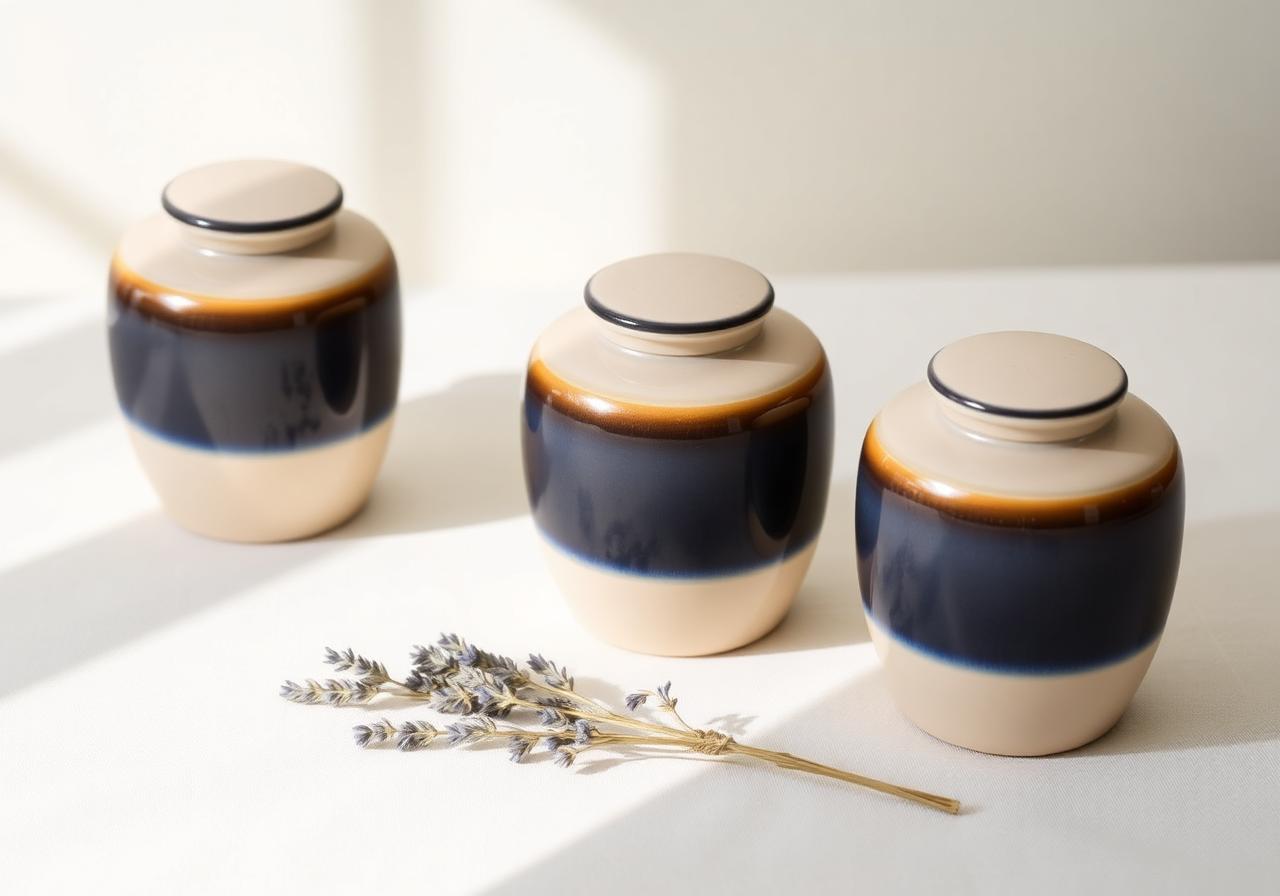
Small keepsake urns may help when several relatives want a personal portion of cremated remains.
What This Guide Covers
- What are small urns for ashes?
- Small urns vs mini urns vs keepsake urns
- Best small urn type by situation
- When families use small urns
- How much ash does a small urn hold?
- Can ashes be divided among family?
- Small urns vs cremation jewelry
- Small urns vs cremation stones
- Small urns vs full-size urns and other options
- Types of small urns
- Personalized small urns
- Small urns for human vs pet ashes
- How much do small urns cost?
- Where to buy small urns
- What to avoid before buying
- Questions to ask before choosing
- Final verdict
- FAQ
What Are Small Urns for Ashes?
Small urns for ashes — also searched as small urns for human ashes, small cremation urns, small urn for ashes, and small urns for cremated remains — are smaller memorial containers made to hold a portion of cremated remains rather than all of them.
They are most often used as keepsake urns when:
- Several relatives want their own personal share of ashes.
- A family pairs one full-size urn with smaller display pieces.
- Ashes are partially scattered or buried, and a small portion is kept at home.
For the wider picture, see our urns for cremation ashes overview and what to do with ashes after cremation.
Small Urns vs Mini Urns vs Keepsake Urns
The terms overlap, but here is how sellers most often use them.
Small urns
Hold a portion of ashes — useful for family sharing or a small memorial display.
Mini urns
Usually the smallest format. Hold a very small portion or work as paired keepsakes.
Keepsake urns
Broad term for any small memorial container with a portion of ashes — most small and mini urns qualify.
Full-size adult urns
Designed for most or all of an adult's cremated remains in one main container.
| Type | Usually used for | Holds all ashes or a portion? | Best for | Main thing to check |
|---|---|---|---|---|
| Full-size urn | One central memorial container | Most or all of an adult's ashes | Families who want one main urn at home, in a niche, or for burial | Listed interior capacity vs the amount of ashes returned |
| Small urn | A personal portion in a small container | A portion only | Sharing among a few relatives or pairing with a main urn | Listed capacity and how the lid or base closes |
| Mini urn | Very small portion or paired keepsake | A very small portion | Tiny memorial display or a token keepsake | How small the interior really is — confirm with the seller |
| Keepsake urn | Personal share for one relative | A portion (varies widely) | Each relative receiving their own piece | Exact product capacity — the term is broad and varies by seller |
| Cremation jewelry | Wearable daily keepsake | A tiny portion (or none, if cremains are infused) | Relatives who want to wear a remembrance | Compartment seal, metal, and how it is filled |
| Cremation stones | Touchable, shareable stone-like pieces | A larger portion or all of the ashes | Families who want shareable keepsakes without loose ashes | Process, lead time, and current pricing with the provider |
Best Small Urn Type by Situation
A quick way to narrow the choice. Find the situation closest to yours.
If…
Several family members want a portion
ConsiderSmall keepsake urns (often a matching set)
If…
One person wants a tiny memorial
ConsiderMini urn
If…
Family wants a main urn plus keepsakes
ConsiderFull-size urn + small urns
If…
Wants wearable remembrance
ConsiderCremation jewelry for ashes
If…
Wants touchable, shareable keepsakes
ConsiderCremation stones
If…
Wants a memory display
ConsiderSmall urn paired with a photo, candle, or flowers
If…
Not ready to divide ashes
ConsiderKeep ashes safely in one container for now
If…
Wants cemetery burial
ConsiderConfirm cemetery-approved urn requirements first
When Families Use Small Urns for Ashes
Common situations where small urns help:
- Dividing cremated remains among children, siblings, a spouse, or close relatives.
- Keeping a small portion at home while scattering the rest.
- Keeping a small portion after cemetery burial or niche placement.
- Building a quiet home memorial shelf with a candle, photo, and flowers.
- Pairing ashes with a photo frame, memory box, or favorite small belonging.
- Giving each close family member a personal keepsake at the memorial service.
How Much Ash Does a Small Urn Hold?
Capacity varies by product and seller — there is no single industry standard, so we do not publish guessed measurements.
- Small urns usually hold only a portion of an adult's ashes — not the full amount.
- Mini urns usually hold a very small portion, sometimes just a token amount.
- Keepsake urn is a broad term, so always check the exact product capacity rather than the label.
- Do not guess if you need a specific capacity — ask the funeral home, crematory, or urn seller.
- If you are buying a matching set, confirm the capacity for each piece (some sets vary).
- Keep any remaining ashes safely labeled and stored in a secure container until the family decides what to do next.
When in doubt, the funeral home or crematory can help measure the small portion needed for each keepsake.
Can Ashes Be Divided Among Family Members?
Yes. Many families divide cremated ashes among relatives. Small urns, mini urns, keepsake urns, cremation jewelry, and cremation stones can all help with sharing ashes among family.
A short decision checklist before dividing:
- Talk with family before dividing ashes — even a brief conversation prevents stress later.
- Decide whether there will be one main urn plus smaller keepsakes, or several keepsakes only.
- Count how many relatives actually want a portion before ordering urns.
- Consider small urns, keepsake urns, cremation jewelry, or cremation stones for each relative.
- Pause if family members disagree — there is no rule that ashes must be divided immediately.
- Consider the loved one's wishes, culture, faith, and family expectations before making the final decision.
For the wider picture, see what to do with ashes after cremation.
Small Urns vs Cremation Jewelry
- Small urns are displayed or stored, and typically hold more ashes than jewelry.
- Cremation jewelry is worn and uses a very small portion of ashes inside a sealed compartment or incorporated into the design.
- Jewelry may be better for relatives who want a wearable, daily reminder.
- Small urns may be better for relatives who do not want to wear ashes.
- Many families combine both — for example, a small urn at home for one relative and jewelry for another.
For a deeper look, see our cremation jewelry for ashes guide.
Small Urns vs Cremation Stones
Small urns and cremation stones serve different but related needs:
- Small urns keep a portion of loose ashes inside a familiar container.
- Cremation stones (also called solidified remains) transform ashes into smooth, touchable stone-like pieces.
- Small urns may be better for families who want a familiar, lower-cost keepsake container.
- Cremation stones may be better when family members want touchable, shareable keepsakes without loose ashes.
- Neither is universally better. The right choice depends on budget, family agreement, comfort with ashes, tradition, and the loved one's wishes.
For a deeper comparison, see our cremation stones explainer, the turn ashes into stones guide, our Parting Stone review, the Parting Stone cost breakdown, and our Parting Stone alternatives comparison.
Ad · Affiliate
Cremation stones may be worth comparing if your family wants a touchable, shareable alternative to keeping ashes in small urns. Parting Stone walks through their process and current pricing — there is no pressure to decide today.
See How Parting Stone WorksSmall Urns vs Full-Size Urns and Other Options
A side-by-side comparison of the most common formats families weigh.
| Option | Best for | All or portion? | Easy to share? | Display at home? | Wearable? | Main drawback |
|---|---|---|---|---|---|---|
| Full-size urn | One central memorial | All remains | No (single container) | Yes | No | Stays in one place |
| Small urn | A portion in a small container | Portion | Yes | Yes | No | Holds only a portion |
| Mini urn | Very small portion or paired keepsake | Small portion | Yes | Yes | No | Capacity is very limited |
| Keepsake urn | Personal share for one relative | Portion | Yes | Yes | No | Need one per relative for sharing |
| Cremation jewelry | Wearable personal keepsake | Tiny portion | Yes (multiple pieces) | Optional | Yes | Small pieces can be lost |
| Cremation stones | Touchable, shareable alternative | Larger portion | Yes | Yes | No | Higher upfront cost |
Always confirm capacity and details with the seller before buying.
Types of Small Urns for Ashes
A calm overview of the most common small-urn formats. None is universally best — the right one fits the family's wishes and the way the urn will be displayed.
Metal small urns
Best for
Durable everyday display or travel
Often stainless steel, brass, pewter, or aluminum. A familiar starting point for matching family sets.
What to consider
Finish (brushed, polished), weight, and engraving options.
Main drawback
Some metal finishes show fingerprints or scratches over time.
Wooden small urns
Best for
A warm, traditional look
Hand-finished wooden urns are popular for home shelves. Confirm the closure (screw base or insert) and any engraved plate options.
What to consider
Wood type (oak, walnut, cherry), finish, and how it ages indoors.
Main drawback
Wood can warp in damp environments; not always ideal for outdoor placement.
Ceramic small urns
Best for
Soft, calm display pieces
Ceramic and porcelain small urns come in many quiet finishes — matte, satin, or glossy — and are often available in matching family sets.
What to consider
Glaze quality, weight, and how the lid seals.
Main drawback
Ceramic can chip or crack if dropped.
Marble or stone small urns
Best for
A heavier, more permanent feel
Solid marble, granite, or natural stone keepsakes feel substantial and timeless. Confirm whether the closure is sealed or removable.
What to consider
Veining, polish, and weight (some are noticeably heavy).
Main drawback
Cost is usually higher than wood, ceramic, or metal.
Glass small urns
Best for
An artistic display piece
Glass keepsakes range from simple sealed forms to hand-blown art pieces. Some studios incorporate a small amount of ashes into the glass itself.
What to consider
Whether the glass is hand-blown, pressed, or includes incorporated ashes.
Main drawback
Fragile; not ideal for households with small children or pets nearby.
Heart-shaped keepsake urns
Best for
A sentimental keepsake for one relative
Heart-shaped keepsakes are one of the most familiar small-urn forms. Available in metal, wood, ceramic, and stone.
What to consider
Whether it is freestanding or designed to sit on a shelf or stand.
Main drawback
Shape can limit how it pairs with other display pieces.
Teardrop keepsake urns
Best for
A discreet, minimalist memorial
Teardrop and cylindrical keepsake urns offer a quiet, modern look that works on a shelf or in a memory box.
What to consider
Size — many teardrops are quite small.
Main drawback
Capacity is usually very limited.
Photo keepsake urns
Best for
Combining a photo and a small portion of ashes
Photo keepsake urns include a small frame area on the front or top. A sentimental option for a single bedside or shelf memorial.
What to consider
Photo size, frame quality, and how the ash compartment is closed.
Main drawback
Frames and photos may fade over time without protection.
Engraved small urns
Best for
Names, dates, or short inscriptions
Engraving can be added to most metal, wood, marble, and ceramic small urns. Always preview before approving.
What to consider
Spelling, font, lead time, and proof approval before production.
Main drawback
Engraved orders are usually non-refundable once produced.
Matching family sets
Best for
When several relatives each want a keepsake
Many sellers offer 2-, 3-, 4-, or 6-piece matching sets so each family member receives a coordinated small keepsake urn.
What to consider
Number of urns, total cost, and shipping timeline.
Main drawback
All urns share the same look, which may not suit every relative.
Personalized Small Urns
Many sellers offer personalization on small urns, including:
- Names, dates, and short inscriptions.
- Symbols, religious icons, military themes, or nature designs.
- Photo plates or small framed photos on the front.
- Custom finishes or color accents on certain materials.
Personalization can make a small urn feel more meaningful, but engraved or custom orders are usually non-refundable. Confirm spelling, dates, lead time, preview options, and return policy before approving.
Small Urns for Human Ashes vs Pet Ashes
This guide focuses primarily on small urns for human ashes. Pet ashes often use smaller urns or different designs — paw-print motifs, photo collars, or pet-specific keepsake forms.
Pet owners may also compare pet urns with pet cremation stones, pet ashes jewelry, and paw-print memorials. See our pet cremation stones guide for that comparison.
How Much Do Small Urns for Ashes Cost?
Pricing varies widely. The biggest factors are:
- Material — metal, wood, ceramic, marble, glass, or premium stone.
- Size and capacity — small vs mini formats.
- Craftsmanship — handmade or artisan urns price higher than mass-produced ones.
- Personalization — engraving, photo plates, or custom artwork add cost.
- Sets vs single urns — matching family sets often have a per-piece discount.
- Shipping and turnaround — rush options may cost more.
We do not publish exact prices because they change often. Always confirm pricing, shipping, and return policy with the seller before placing an order. For broader cost context, see our cremation vs burial costs guide.
Where to Buy Small Urns for Ashes
Families generally compare several sources:
- Funeral homes — often offer a curated selection and can advise on matching the main urn.
- Crematories — may sell directly, especially for basic small urns.
- Online urn stores — broad catalogs, many materials, and matching family sets.
- Memorial product shops — specialized brands focused on keepsakes and customization.
- Local monument or memorial providers — useful when matching a niche or marker.
- Handmade sellers — artisan ceramic, wood, or glass keepsakes.
Buyer Checklist
- Listed interior capacity for the amount of ashes.
- Material and finish that fit how the urn will be displayed.
- Design — heart, teardrop, cylinder, photo, or a matching shape.
- Personalization options and proof preview.
- Number of urns needed for relatives.
- Whether the urn opens and closes securely (screw base, insert, sealed).
- Shipping time — especially before a planned service.
- Return policy and warranty.
- Engraving preview and approval before production.
- Whether matching urns are needed for several family members.
What to Avoid Before Buying Small Urns
A few common mistakes worth side-stepping before placing an order.
- Do not buy before confirming the listed capacity for the amount of ashes.
- Do not assume a mini urn holds the same amount as a small urn.
- Do not forget to count how many family members want a keepsake.
- Do not choose only by appearance — check material and how the urn closes.
- Do not ignore shipping time if the urns are needed before a memorial service.
- Do not rush if family members disagree about dividing ashes.
- Do not forget that cremation jewelry or cremation stones may fit some relatives better.
- Do not skip the return policy — engraved orders are often non-refundable.
Questions to Ask Before Choosing Small Urns
- How many people want a portion of ashes?
- Will there also be a main full-size urn?
- How much ash should each small urn hold?
- What material feels right for the way it will be displayed?
- Do you want matching urns or different styles per relative?
- Is engraving or personalization important?
- Will the urn be displayed, stored, or placed inside a memory box?
- Is the family comfortable dividing ashes?
- Would cremation jewelry or cremation stones fit better for some relatives?
- What did the loved one want?
- Is everyone ready to decide, or is more time needed?
Final Verdict
Small urns for ashes can be a thoughtful option when several family members want a personal keepsake or when a family wants to keep only a portion of cremated remains in a small memorial container.
They are not the only option. Full-size urns, cremation jewelry, cremation stones, scattering, burial, and memory boxes may fit different families better depending on budget, tradition, family agreement, and emotional comfort. Many families combine more than one.
Ad · Affiliate
If your family is comparing small urns with newer memorial options, cremation stones may be worth learning about before you decide. See How Parting Stone Works →
Editorial Note
WVFuneralBoard is an independent funeral planning resource and does not replace legal, religious, cemetery, funeral, financial, or travel advice. Always confirm urn capacity, material, closure, seller policies, shipping, return policy, and timing directly with the provider before buying.
Frequently Asked Questions
Related Guides
Urns
Urns for Cremation Ashes
Compare
Parting Stone vs Urn
Keepsake
Keepsake Urns for Ashes
Overview
What to Do With Ashes After Cremation
Jewelry
Cremation Jewelry for Ashes
Explainer
What Are Cremation Stones?
How It Works
Turn Ashes Into Stones
Review
Parting Stone Review
Cost
Parting Stone Cost
Compare
Parting Stone Alternatives
Pets
Pet Cremation Stones
Cremation
Direct Cremation Guide
Costs
Cremation vs Burial Costs