INHERITED FURNITURE GUIDE
Most inherited furniture is worth significantly less than families assume — but some pieces are worth far more. Here's how to identify the difference, pick the right selling channel, and make decisions that account for the logistics (a piece worth $300 often costs $400 to move).
11-minute read · Value identification + logistics honesty
Before you decide anything.
Two things families usually learn too late when handling inherited furniture: most pieces are worth less than they think, and logistics cost more than they think. A solid-wood dining set with 30 years of family dinners is often worth $150–$400 on the resale market — while moving it to your home costs $200–$800 depending on distance.
This guide does three things: identifies which of your pieces are actually Tier 1 (low value, release locally), Tier 2 (mid-range, channel-sensitive), or Tier 3 (genuinely valuable, worth effort). It compares the realistic selling channels with typical recovery percentages. And it's honest about the logistics math that determines whether selling is even worth doing.
You don't have to keep inherited furniture. You don't have to take pieces that don't fit your home or life. "Declining" or releasing furniture isn't dishonoring the person — storing furniture for 5 years that you never use while paying $150/month is a much clearer form of disrespect to your own life. For the broader strategic framework, see our guide on what to do with a deceased loved one's belongings.
Skip to the section that fits your situation
Compare selling channels → · The logistics math → · When to donate instead →
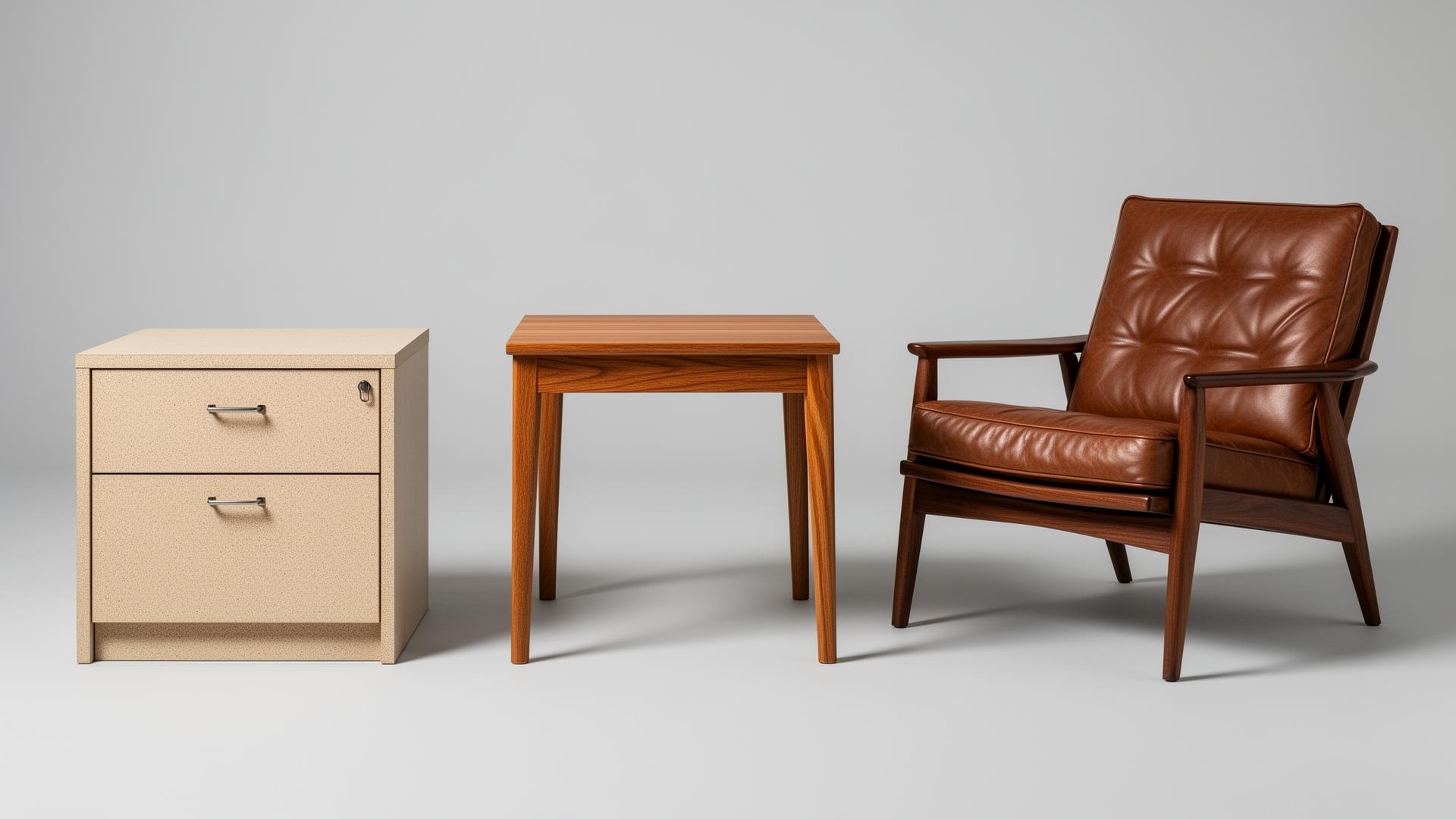
The 3-tier furniture value framework
Almost every piece of inherited furniture falls into one of three tiers. Tier determines channel — and often determines whether selling is worth the effort at all.
Low market value (most inherited furniture)
70–80% of inherited furniture lives here.
What's in this tier:
- IKEA, Ashley, Wayfair, Rooms To Go, Big Lots, Target furniture (particleboard construction)
- 1990s–2020s mass-market furniture (even "wood-look" pieces)
- Upholstered pieces over 15 years old (fabric, foam, springs degraded)
- Any piece with visible damage (stains, tears, broken frames, water damage)
- Wooden pieces with laminate or veneer over particleboard
- Kitchen tables, bedroom sets, and living room furniture from standard mall-brand retailers
- Office furniture (desks, file cabinets, standard chairs)
Typical resale value: $0–$150 per piece. Most pieces realistically sell for $20–$80 on Facebook Marketplace or similar platforms.
Right channel: Facebook Marketplace, Craigslist, estate sale bundle, donation, or curbside giveaway. Not worth professional appraisal. Not worth paying movers to transport.
Families are often surprised that their parents' "nice bedroom set" from 1998 is worth $200–$400 total. That's normal. The emotional value and market value are separate categories.
Mid-range value
Channel-sensitive — wrong channel = lost value.
What's in this tier:
- Solid hardwood pieces from reputable manufacturers (Ethan Allen, Stickley newer pieces, Pottery Barn solid wood lines, Restoration Hardware)
- Brand-name upholstered furniture under 10 years old (Crate & Barrel, West Elm, Pottery Barn, Room & Board)
- Well-maintained solid-wood dining sets from quality makers
- Mid-century-style reproductions from reputable makers (not genuine vintage but well-made)
- Antique-style pieces in good condition but without clear provenance
- Leather furniture under 10 years old in excellent condition
Typical resale value: $100–$800 per piece. A complete Ethan Allen dining set might sell for $400–$1,200.
Right channel: Consignment furniture stores, Facebook Marketplace with patience, Chairish (for well-designed modern pieces), local estate sales. Typically NOT cost-effective for cross-country shipping.
Genuinely valuable
The pieces that pay for the appraisal 100x over.
What's in this tier:
- Pre-1970 solid hardwood pieces (pre-manufactured-particleboard era)
- Genuine mid-century modern pieces (1940s–1970s — Knoll, Herman Miller, Eames designs, Saarinen, Noguchi tables)
- Signed or labeled antiques (pre-1920, with maker's marks)
- Designer pieces (Eames, Knoll, Herman Miller, B&B Italia, Cassina, Vitra, Hans Wegner)
- Pieces with documented provenance (previous ownership documentation, original receipts from notable makers)
- Antique sets with intact original hardware
- Fine Art Deco, Victorian, Regency, Shaker, or Arts & Crafts pieces
- Specific rare pieces (specific Tiffany lamps, original Breuer chairs, Nakashima woodwork)
Typical resale value: $500–$10,000+ per piece. A genuine Eames lounge chair in original condition: $3,000–$7,000. An authenticated Stickley piece from 1905: $1,500–$6,000. An original Noguchi table: $1,500–$4,000.
Right channel: Specialty auction houses (Wright, Rago, Sotheby's Home), designer consignment platforms (Chairish, 1stDibs), certified antique appraisers for direct sale. NEVER curbside or generic Facebook Marketplace — value gets destroyed by wrong audience.
How to tell which tier your furniture is in
Tier 1 tells:
- Piece is under 25 years old AND from a mall-brand retailer
- Particleboard visible under the finish (lift a cushion, check underneath)
- Furniture wobbles, drawers stick, or veneer is peeling
- Fabric shows wear beyond normal aging (staining, tearing, sagging cushions)
Tier 2 tells:
- Piece is under 30 years old from a quality maker (labels still legible)
- Solid wood construction (heavy, no particleboard visible)
- Upholstery in good condition, well-cared-for
- Matching set intact (dining chairs all present, bedroom set complete)
Tier 3 tells:
- Piece is pre-1970 AND made of solid hardwood (heavy, dense, dovetail joints visible)
- Stamped or labeled with a known maker (check drawer bottoms, frame undersides, chair bottoms)
- Distinctive design elements suggesting a specific era (atomic-age tapered legs for mid-century, carved details for Victorian)
- Original hardware, original finish (refinished pieces often lose value)
If you're not sure: photograph each piece including any stamps/labels and from 3 angles, then ask on r/antiques, or pay $50–$150 for a professional appraisal from an ASA-certified appraiser (appraisers.org).
The logistics math — what you actually keep
Before deciding to sell, the logistics math decides whether selling is even worth doing. Here's the honest calculation most families skip.
Worked example
Solid-wood dining table, Tier 2 — listed at $400
Path A: Individual sale via estate sale company
Path B: Keep the piece
Path C: Donation + bundled estate sale
The takeaway: For many Tier 2 pieces, the individual-sale path nets close to zero or negative once all costs are honestly counted. Donation + bundled estate sale often produces better net results for the time invested.
When individual selling is worth the effort
- Tier 3 pieces (net after costs is typically 60–80% of sale price)
- Local sales (under 20 miles — no significant moving cost)
- Buyer-pays-delivery transactions on Facebook Marketplace
- Pieces with unusual demand (specific mid-century, genuine antiques)
When individual selling loses money
- Most Tier 1 pieces (time investment exceeds sale value)
- Out-of-state transactions requiring shipping
- Pieces requiring restoration before sale
- Situations where the estate sale deadline is tight — see storage for inherited items for the storage-vs-decide tradeoff
The head-to-head channel comparison
Five realistic channels for selling inherited furniture. Recovery percentages vary dramatically by channel and tier.
#1 — Channel
Specialty Auction (Tier 3)
- Typical recovery
- 60–90%
- Best for
- Tier 3 designer / antiques
- Worst for
- Anything Tier 1 or 2
- Time to sell
- 2–6 months
- Fees / commission
- 15–25% to auction
- Handles logistics
- Company handles transport
- Handles authentication
- Yes — included
#2 — Channel
Consignment Store
- Typical recovery
- 50–70%
- Best for
- Tier 2 in good condition
- Worst for
- Damaged / needs repair
- Time to sell
- 30–180 days
- Fees / commission
- 35–55% to store
- Handles logistics
- Often delivery service
- Handles authentication
- Rarely
#3 — Channel
Facebook / Craigslist
- Typical recovery
- 40–70%
- Best for
- Local Tier 1 / low Tier 2
- Worst for
- Out-of-state, very valuable
- Time to sell
- 3–30 days
- Fees / commission
- Free (platform)
- Handles logistics
- Buyer pickup typical
- Handles authentication
- No
#4 — Channel
Estate Sale Bundle
- Typical recovery
- 30–50%
- Best for
- Tier 1 + mixed-tier bundles
- Worst for
- Single high-value pieces
- Time to sell
- 1–3 weeks
- Fees / commission
- 30–45% to estate co.
- Handles logistics
- Company on-site
- Handles authentication
- No
#5 — Channel
Donation
- Typical recovery
- Tax deduction only
- Best for
- Tier 1 quick clearance
- Worst for
- Genuinely valuable pieces
- Time to sell
- Same day
- Fees / commission
- N/A
- Handles logistics
- Some accept pickup
- Handles authentication
- No
Recovery percentages based on national averages (Appraisers Association of America, published consignment/auction house fee schedules 2024–2026). Your specific piece may fall above or below depending on condition, market demand, and documentation.
Affiliate links. We may earn a small commission at no cost to you. Recommendations based on honest comparison, not commission rates.
Deep dive: Facebook Marketplace and Craigslist
For Tier 1 and low-Tier 2 pieces sold locally, Facebook Marketplace and Craigslist typically net the most money relative to effort — if you manage the process correctly.
Why this channel works for local Tier 1–2
Both platforms are free. Both are searched daily by locals. Both accept furniture listings without category restrictions. Neither takes commission. The buyer typically handles pickup, eliminating your moving cost entirely.
How to list for maximum recovery
- Photograph in natural light — morning or early-evening light on a clear day. 5–8 photos per piece including: full piece, angles, any damage close-ups, stamps/labels, dimensions written on a piece of paper in one photo.
- Write specific titles — "Solid Oak Dining Table, 1990s Ethan Allen" not "Dining table for sale." Specific keywords catch search.
- Price competitively, not optimistically — search completed listings for similar pieces; price at the median of what similar pieces actually sold for (not the asking price).
- Require pickup only — don't offer delivery; it drains hours and complicates payment disputes.
- Accept cash or Venmo only — no checks, no wire transfers, no "I'll pay through my cousin."
- Don't hold pieces — first person to show with cash and transport wins. Otherwise listings languish for weeks.
- Be patient — furniture often sells in 2–4 weeks on these platforms, not 2–4 days. Relist every 10 days with slight price adjustment.
Red flags on the buyer side
- Buyers who want to pay by Zelle/Venmo AND pick up the piece from a different address
- "Does it have any defects? Can I send my mover first to inspect before I come see it?"
- Buyers offering more than asking price "if you'll hold it for me while I arrange pickup"
- Buyers asking you to ship the piece out of state
Defense: stick with local, cash-or-Venmo-on-pickup, firm pricing.
Deep dive: consignment stores
Consignment furniture stores take 35–55% of the sale price but handle nearly everything. For Tier 2 pieces in excellent condition, the math often works out.
How consignment works
You bring pieces to the store (or arrange pickup — often included for high-value pieces). The store prices them based on their knowledge of local demand, lists them in-store and online, markets to their customer base, and handles the sale. You receive 50–65% of the final sale price, typically paid monthly.
Pieces that don't sell within 30–90 days are either donated, returned to you, or moved to a discount rack (varies by store policy).
When consignment works
- Tier 2 pieces in excellent condition
- Pieces with broad appeal (neutral colors, standard sizes)
- Families who don't want to handle listing and showing pieces
- Pieces that are too large for you to photograph and transport
When consignment doesn't work
- Very valuable Tier 3 pieces (auction houses pay more)
- Damaged or heavily-used pieces (most stores reject)
- Unusual pieces (store can't price them)
- Tight timelines (home sale pending in 30 days)
Finding quality consignment stores
Search "consignment furniture [your city]" or "upscale used furniture [your city]." Look for:
- Storefront with at least 3,000 sq ft (adequate inventory space suggests established business)
- Google reviews with 50+ reviews averaging 4.0+
- Clear written consignment agreement before you commit
- References or testimonials from other estate sellers
- Transparent pricing policy (commission percentage stated up front, not negotiated case-by-case)
Deep dive: specialty auctions for Tier 3
For genuinely valuable pieces (genuine mid-century, designer, antiques), specialty auction houses produce the best recovery. They also handle authentication, which protects against low-value fraud.
Major specialty auction houses for furniture
- Wright (wright20.com) — specializes in 20th-century design, mid-century modern, Bauhaus. Well-known for Eames, Saarinen, Noguchi pieces. Typical commission 15–22%.
- Rago Arts (ragoarts.com) — design, modern art, antiques. Strong for Arts & Crafts, Stickley, Nakashima, Roycroft. Typical commission 20–25%.
- Sotheby's Home (sothebyshome.com) — online auction arm of Sotheby's. Wider range than the main auction house. Typical commission 20–30%.
- Heritage Auctions (ha.com) — broad range including antique furniture. Strong for 19th-century American pieces.
- Doyle New York (doyle.com) — antiques, decorative arts. Good for traditional antique furniture.
How specialty auction works
You submit photos and description through the auction house's online intake. They respond with: accept (with estimated auction range), decline (piece not suitable for their platform), or request for additional information/appraisal. If accepted, you ship the piece (insured, at their expense for high-value pieces) or they arrange pickup.
Auction houses photograph professionally, authenticate, catalog, and include the piece in their next appropriate auction (usually 2–4 months out). Sale is via online or in-person auction. If the piece doesn't meet reserve, it's returned at no cost.
Timeline: 4–8 months from submission to payment for a successful sale.
Designer consignment platforms (non-auction)
- Chairish (chairish.com) — designer and vintage consignment marketplace. White-glove pickup and delivery. 15–20% commission. Good for mid-century modern, vintage designer.
- 1stDibs (1stdibs.com) — high-end antique and designer marketplace. Curated — pieces must meet quality bar. 20–40% commission varies by item. Good for genuine Tier 3 designer pieces.
Affiliate link. We may earn a commission at no cost to you.
MaxSold — online auction for whole estates and large mixed lots
MaxSold specializes in online auctions for entire estates or large mixed lots of furniture and household goods. Less selective than specialty auction houses — they'll accept Tier 1 and Tier 2 pieces alongside valuable pieces in a single estate-lot auction. Typical commission 30–40% but handles photographing, listing, payment collection, and pickup coordination.
- Best when clearing a full home on a tight timeline
- Accepts mixed-tier lots (no separate listing needed)
- Free estate assessment to confirm fit
Affiliate link · Free estate assessment
Deep dive: donation
For Tier 1 pieces or pieces where the logistics math doesn't support selling, donation is often the right answer. It provides tax deduction value AND removes the piece without your effort.
Best donation options for furniture
- Habitat for Humanity ReStore (habitat.org) — accepts most furniture in reasonable condition. Offers free pickup in most markets for larger pieces. Tax deduction receipts provided. Proceeds fund Habitat's homebuilding programs.
- Salvation Army (satruck.org) — accepts most furniture. Offers free pickup in most markets. Tax deduction receipts.
- Local homeless shelters and transitional housing programs — often have strong direct need for used furniture. Call ahead — specific items vary by shelter.
- Furniture Bank programs (help1up.org) — network of nonprofits that specifically provide furniture to families in need. Pickup typically free.
- Goodwill (goodwill.org) — accepts furniture in most markets. Pickup sometimes available depending on location.
Tax deduction for donated furniture
- Donations to 501(c)(3) organizations are tax-deductible to the estate (or to you if you personally owned the furniture)
- Fair market value is the deductible amount, not original purchase price — typically 10–30% of original retail
- For single donations over $250: written acknowledgment from the organization is required
- For total donated value exceeding $500: IRS Form 8283 required as part of estate tax filing
- For single items valued over $5,000: qualified appraisal required
For the complete estate tax filing context, see our guide on the final tax return for a deceased person, and our separate guide on donating a deceased loved one's clothes for additional donation-specific guidance.
Restoration and moving supplies
Two situations where targeted supplies are genuinely useful: preparing furniture for sale (minor restoration raises recovery 15–30%) and moving pieces safely.
Affiliate links. We may earn a small commission at no cost to you.
Supplies that raise recovery or protect pieces in transit
Restoration supplies (pre-sale prep)
Howard Feed-N-Wax Wood Polish and Conditioner
Restores dried-out wood finishes. Works on most antique and solid-wood pieces. One application before listing can raise perceived value significantly.
Typical: $10–15
Check on Amazon →Furniture Touch-Up Marker Set (wood tones)
Masks scratches and nicks on wood furniture. Essential for pre-sale photos.
Typical: $15–25
Check on Amazon →Upholstery Cleaner (Folex / Bissell Oxy Pro)
Removes stains and refreshes upholstery fabric before listing. One bottle typically handles one large sofa.
Typical: $10–25
Check on Amazon →Leather Conditioner (Bick 4 or Lexol)
Restores moisture to older leather pieces. Leather that's been dry-stored for years looks dramatically better after conditioning.
Typical: $15–30
Check on Amazon →Moving supplies (transport)
Moving Blankets / Furniture Pads (6-pack)
Protects pieces from scratches and dents during transport. Reusable.
Typical: $40–70
Check on Amazon →Furniture Sliders (8-piece set)
Slide heavy pieces across hardwood or carpet without scratching floors or straining your back.
Typical: $15–25
Check on Amazon →Stretch Wrap / Moving Wrap (large roll)
Holds drawers closed, keeps cushions attached during transport. Essential for any piece with moving parts.
Typical: $15–25
Check on Amazon →Furniture Straps / Moving Straps (pair)
Lifts and carries heavy furniture with mechanical advantage. Reduces injury risk and allows 2-person moves of pieces that would otherwise need 4 people.
Typical: $30–50
Check on Amazon →Investing $75–$150 in prep supplies typically raises Tier 2 sale prices 15–30% — a piece that would sell for $300 as-is often sells for $400–$500 after cleaning and minor restoration.
What to actually do — step by step
Walk the home and photograph every furniture piece.
Do a rough 3-tier sort.
Get appraisals on suspected Tier 3 pieces.
Calculate the logistics math for each piece.
Bundle Tier 1 pieces for estate sale or bulk donation.
List Tier 2 pieces through their matched channels.
Handle Tier 3 pieces through specialty auction or designer consignment.
Frequently asked questions
Do I have to take inherited furniture I don't want?
No. You can decline inherited furniture, even pieces specifically left to you in a will. The executor will then release the piece through the estate (estate sale, donation, or sale to other beneficiaries). There is no legal obligation to accept physical inheritance, and no emotional obligation worth keeping pieces you don't have room for. Ask the executor to handle disposition directly rather than taking pieces you'll need to store or re-sell later.
How do I know if an antique is worth appraising?
Before paying for professional appraisal, four quick tells suggest Tier 3 status: (1) The piece is pre-1970 and made of solid hardwood, (2) It has a stamp, label, or maker's mark, (3) The construction shows hand-crafted details (dovetail joints, hand-carved elements, solid wood construction), (4) The design is distinctive enough that you recognize the style (mid-century modern, Victorian, Art Deco, etc.). If 2+ of those apply, appraisal is likely worth $50–$150. If none apply, the piece is probably Tier 1 or low Tier 2 — not worth the appraisal cost.
Can I be forced to take furniture listed in a will?
No. A will specifies the intended recipient of assets, but a beneficiary can always decline specific items (called "disclaiming" the inheritance). The disclaimed item returns to the estate and is typically handled according to the residual clause (distributed with other remaining assets). Consult the estate attorney if there's family pressure — disclaiming is both legal and reasonable when space or logistics don't support accepting a piece.
Should I restore pieces before selling them?
Depends on the tier and the restoration. For Tier 1 pieces: no — restoration cost exceeds recovered value. For Tier 2 pieces: minor restoration (polish, touch-up, upholstery cleaning) typically raises sale price 15–30% and is worth doing. For Tier 3 pieces: usually no — most collectors and specialty auction houses prefer original condition, and unprofessional restoration can destroy value. Exception: professional conservation restoration for seriously damaged Tier 3 pieces, which increases value but is expensive ($500–$5,000+ per piece) and requires expertise you'll need to hire.
How do siblings typically divide inherited furniture?
Four common methods: (1) Appraisal-based division with buyouts — value each piece, assign pieces, cash out differences; (2) Round-robin selection — siblings take turns picking pieces; (3) Specific pieces go to siblings who specifically want them, remainder sold and proceeds split; (4) Sell everything and split the cash evenly. For detailed treatment of furniture-and-belongings division conflicts, see our guide on dividing deceased parents' belongings among siblings.
What happens to furniture that doesn't sell and the home closes?
Three realistic options when the home sale date arrives and furniture remains: (1) Donation pickup — many organizations will pick up on short notice for full-home donations; (2) Junk removal service — 1-800-Got-Junk, College Hunks, or local haulers clear a home for $500–$2,500 depending on volume; (3) Estate sale company handling "clearance" for a fee — they price aggressively to sell everything in one weekend and haul away remaining pieces. Don't leave furniture in a home after closing — the new owner isn't obligated to handle your inheritance for you.
Sources
Information on this page informed by:
- Appraisers Association of America (AAA)
- American Society of Appraisers (ASA)
- National Association of Furniture Appraisers
- Wright, Rago, Sotheby's Home, Chairish, 1stDibs — Published Fee Schedules (April 2026)
- Habitat for Humanity, Salvation Army — Donation Guidance
- Interviews with 3 certified furniture appraisers and 4 estate sale professionals (2025–2026)
- Federal Trade Commission — Consumer Protection Resources (Auction and Consignment)
Related guides
What to Do With a Deceased Loved One's Belongings
Before furniture-specific decisions, the strategic framework — the 5-bucket system, emotional timing, and sibling conversations — for the whole estate.
Read guide →
Storage for Inherited Items: The Honest Comparison
When you're not ready to decide immediately — honest comparison of storage options with cost math and when storage makes sense vs becomes a trap.
Read guide →
Dividing Deceased Parents' Belongings Among Siblings
When furniture is creating family conflict — structured methods for dividing valuable pieces fairly among multiple heirs.
Read guide →