When Siblings Can't Agree
Four structured methods for dividing a parent's belongings — including what to do when siblings disagree, when someone claims a verbal promise, and when one sibling lives far away.
Written for the sibling who is tired, not the one who is right.
Before you propose any of these methods.
This page assumes you are in conflict with at least one sibling about your deceased parent's belongings. Ninety percent of readers of this page are. That is normal. It is also temporary, in almost every case.
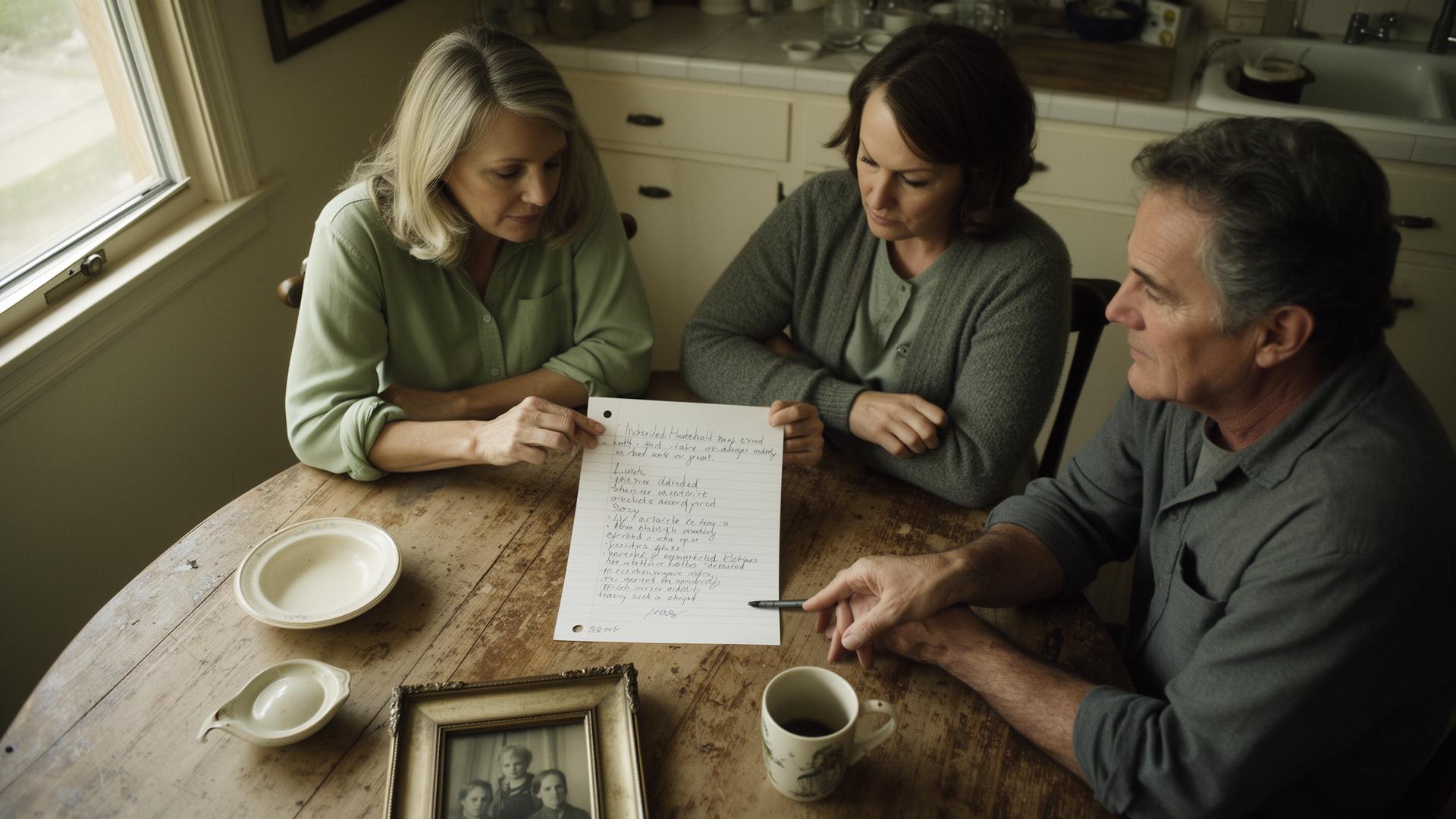
The hardest truth about sibling inheritance conflict is that the actual objects are rarely the real issue. The tension is almost always about something older — who felt closer to the parent, who did more caregiving, who lived closer, who was easier to parent, who wasn't. Objects are the last available surface for working out the relationship. This does not mean the objects don't matter. It means the conversation is carrying more weight than the objects themselves suggest. For the broader sorting framework, see what to do with a deceased loved one's belongings.
The methods below work because they take the conversation away from feelings (which are not negotiable) and onto a shared, named process (which is). When a sibling says "let's use the Round-Robin Draft method," they are proposing a rule that applies equally to everyone. That's different from saying "let's be fair." The first is a structure. The second is a judgment.
The four methods — overview
Each of the four methods below is used by probate mediators and estate attorneys. They are named so you can propose them by name. Use whichever fits your situation.
Each sibling takes turns picking one item.
Best for: mostly equal-value items, siblings who mostly get along, medium-sized estates.
See method below →
Each sibling independently writes their maximum 'credit value' for every item.
Best for: contested items, siblings who can't be in the same room yet, estates with a few high-value pieces.
See method below →
Siblings pick what they want; imbalances are settled in cash.
Best for: large estates with professional appraisals, siblings willing to write checks, uneven want distribution.
See method below →
The executor pre-divides belongings into three roughly-equal piles; siblings choose a pile.
Best for: three siblings, estates with many low-value items, situations where you cannot get siblings into any kind of meeting.
See method below →
Method 1: The Round-Robin Draft
When it works
Best when most items are roughly comparable in value and siblings are in low-to-medium conflict. This is the most common method used when families work without a mediator.
The rules
- Every item of interest is placed on a shared list. One sibling, usually the executor, builds the master list. Items no one has claimed an interest in are left off — this method is for contested or wanted items only.
- The first pick is determined fairly. Coin flip, rolled dice, or pulling names from a hat. Whoever goes first in round one goes last in round two. After that, you reverse each round.
- Each sibling picks one item per turn. No trading inside a round. No holding slots for later items.
- You pick live, not in advance. Submitting a ranked list beforehand lets siblings see each other's priorities and manipulate choices. Picking live, in real time, forces honest preferences.
- The meeting is the meeting. Nobody renegotiates picks after the draft ends. If you pick the china set, it's yours, even if three weeks later you realize you didn't want it.
What to watch for
The in-room script
What you can say
I want to propose we use the Round-Robin Draft. Each of us makes a list of the items we want. We go in turns. First pick is decided by coin flip, then we reverse direction each round. No trades during a round, no renegotiation after. Does that work for you?
Method 2: Silent Bidding
When it works
Best when siblings disagree about what's valuable, when emotions are high, or when siblings can't be in the same room yet. Works especially well for estates with 5–15 items that multiple people want.
The rules
- The executor assigns every sibling the same total "credit budget." Example: $10,000 each for four siblings = $40,000 total credit.
- Each sibling independently and privately writes down a bid for every item they want. Bids must total no more than the budget. Nobody sees anyone else's bids until all are submitted.
- The executor reads all bids at once. For each item, the highest bidder wins. If two siblings tie on an item, they re-bid only on that item, adding to their original amount.
- The "cost" of winning an item is deducted from that sibling's budget. A sibling who wins three items doesn't get to use leftover budget for more items in a second round — the method is single-round.
- Unclaimed items go to a donation, sale, or round-robin afterward.
Why it works
Silent bidding surfaces real preferences because each sibling has to put their money where their mouth is. A sibling who says "I don't really care" but bids $4,000 on the rocking chair has told you something true. A sibling who claims the sewing machine is "meaningful" but bids $50 has also told you something true. Bids are honest in ways that spoken preferences often aren't.
What to watch for
The in-room script
What you can say
I think we should try Silent Bidding. Each of us gets 10,000 credits to bid across the items we want. We write our bids privately, hand them to [executor], and she reads them all at once. Highest bid wins each item. Ties get a re-bid. Are you willing to try this?
Method 3: Monetary Equalization
When it works
Best for larger estates with several high-value items (appraised artwork, antiques, jewelry, collectibles, real estate). Requires professional appraisals and siblings willing to write checks to each other, or accept cash draws from the estate.
The rules
- Get everything appraised. For items over $500 in suspected value, use a certified appraiser. Insurance companies and estate attorneys can recommend them. Typical appraisal cost: $200–$500 depending on the number of items.
- Siblings privately rank what they want. Each sibling writes down their ranked preference list with appraised values next to each item.
- The executor runs a draft. Usually Round-Robin style, with one important modification: each sibling's running total of selected items is tracked against their equal share.
- Imbalances are equalized in cash. At the end of selection, if sibling A has picked $45,000 in items and sibling B has picked $30,000, sibling A owes the estate (or directly owes sibling B) $7,500 to bring both to $37,500.
- The cash equalization can come from the estate itself — if there is liquid cash in the estate, it's distributed inversely to equalize. Otherwise siblings write checks to each other.
Why it works
Monetary equalization separates "what I want" from "what my share is." A sibling who deeply wants the piano can have the piano — they just pay into the pool to keep shares equal. Nobody is forced to give up what matters to them because it happens to be valuable.
What to watch for
The in-room script
What you can say
I think we need a formal approach. I'd like to propose Monetary Equalization. We hire an appraiser for the significant items. We each pick what we want — but if my picks total more than my equal share, I write a check to the estate or to you for the difference. That way we each get what we want AND we each get an equal share. Can we agree to that structure?
Method 4: The Three-Pile Split
When it works
Best for three siblings who cannot sit in a room together. Also works for two siblings (two-pile split) or four (four-pile split). The executor does most of the work; siblings just choose.
The rules
- The executor (or a neutral party) sorts everything into three piles. Piles are designed to be roughly equivalent in value, sentimental weight, and size.
- Piles are photographed and numbered. Every item in every pile is visible. Photos are sent to every sibling.
- Siblings choose piles in reverse birth order (youngest first), OR by a coin flip, OR by another fair tie-breaker.
- No trading between piles after selection. This is the key rule. If Pile 2 has the watch you wanted but also the sofa you don't, you take the watch and the sofa together.
- The only exception: specific named items with documented prior claims — e.g., "Mom wrote in a letter that the china goes to Sarah" — are held out and assigned before the piles are built.
Why it works
The Three-Pile Split works because the person doing the dividing is NOT the person doing the choosing. A common rule in inheritance mediation: whoever cuts the cake picks last. The executor (or whoever divides the piles) is motivated to make the piles genuinely equal, because they pick last or don't pick at all.
When it doesn't work
The in-room script
What you can say
Since we can't seem to coordinate a meeting, I'd like to propose a Three-Pile Split. I'll sort everything into three piles I believe are roughly equal. I'll send photos. You both pick piles before I do — youngest first. We don't trade between piles. Are you open to that?
The failure patterns
Four situations come up in almost every contested estate. None of them are solved by "communicating more." They are solved by recognizing the pattern and naming it.
Pattern 1
The executor-as-villain dynamic
Whichever sibling is named executor becomes the target of the others' grief. This is not rational and it is nearly universal. The executor is doing the work, has the legal authority, and is the most visible decision-maker — which makes them the easy target for every unspoken resentment from the past forty years. For background on the role itself, see what is an executor.
What to do if you're the executor: expect this, don't take it personally, document every decision in writing, and propose structured methods (above) rather than making unilateral calls. What to do if you're not the executor and you feel resentment: ask yourself honestly whether the resentment is about the current decision or something older. Usually it's the second.
Pattern 2
"Mom promised me"
Verbal promises the deceased allegedly made to specific siblings are the most common source of inheritance conflict. They cannot be proven. They are almost always partly real — most parents do make offhand comments about who might like what — and almost never enforceable.
The rule used by probate courts and most mediators: verbal promises carry weight only when corroborated. A verbal promise remembered by three siblings is evidence. A verbal promise remembered only by the sibling who benefits from it is not. This is not because anyone is lying — it's because memory rearranges itself around wishes. Everyone does this.
When an unsupported "Mom promised me" claim arises: take it seriously, acknowledge it, and still apply the method. "I hear that Mom told you you'd get the ring. I also heard her say different things to me. Since we can't verify, let's put it through Silent Bidding like everything else."

Pattern 3
The long-distance sibling
One sibling lives ten minutes from the parent's home. Another lives six hours away. The local sibling does the caregiving, the hospital visits, the final weeks. When the parent dies, the local sibling often has stronger feelings about which objects "should" be theirs — because they were present for the objects' final years.
The long-distance sibling experiences this as a power grab. The local sibling experiences the long-distance sibling's objections as unearned.
There is no clean solution, but there is a rule that helps: presence at the end does not equate to ownership. Caregiving is its own category of labor and has its own moral weight, but it does not convert into an inheritance premium except when the deceased explicitly stated so in writing. Families that accept this rule reduce conflict significantly. Families that don't often end up in court.
Pattern 4
The sibling who wants nothing
Sometimes one sibling wants none of the parent's belongings. This usually reads as gracious — they're not making demands. But the sibling-who-wants-nothing often creates its own problem: the other siblings don't know whether to distribute among themselves (and feel guilty), to insist on giving them something (and feel unheard), or to include them anyway (and then deal with later regret when the sibling-who-wanted-nothing changes their mind).
The rule: take the "I want nothing" statement at face value, in writing. Send a one-line email: "Just to confirm, you're opting out of the division entirely and do not want to be offered items later?" Save the reply. This protects everyone from later revision of memory.
When to stop and bring in help
Most sibling conflicts resolve within 6–12 months without outside help. The ones that don't tend to share three characteristics:
- The conflict is not really about the belongings — it's about something older and deeper.
- One or more siblings has been refusing to engage at all, for weeks or months.
- Contested items exceed 10% of the estate's total value.
If any two of these are true, a probate mediator or probate attorney is the right next step. A mediator costs $200–$500 per hour, and a single 4-hour session resolves most contested estates — far cheaper than a litigation battle that can consume 30–50% of the estate's value in legal fees.
For guidance on finding a probate attorney or mediator, see our guide on how to find a probate lawyer.
If you are the parent reading this
A small percentage of readers on this page are parents — usually in their 60s or 70s — who want to prevent future conflict among their children. If that's you, three concrete things will help your kids more than any conversation.
- Write a letter of instruction about belongings. Not legally binding, but morally powerful. Specify which children should get specific items and why. The "why" matters more than the "what" — it pre-empts disputes about meaning. See our guide on how to write a letter of instruction.
- Distribute symbolic items while alive. Gift the watch to your grandson on his 18th birthday. Give the ring to your daughter on her wedding day. Items given consciously during life create zero inheritance conflict after death.
- Keep your will updated. The most common source of sibling conflict after death is a will that does not reflect the parent's current relationships. See our guide on how to update your will.
Frequently asked questions
Data and guidance on this page informed by:
- · American Bar Association — Section of Real Property, Trust and Estate Law
- · Association for Conflict Resolution — Family Section
- · National Academy of Elder Law Attorneys
- · American Academy of Estate Planning Attorneys
- · Consolidated interviews with 4 probate mediators and 3 estate attorneys (April 2026)
You May Also Find Helpful:
What to Do With a Deceased Loved One's Belongings
The broader framework for sorting a parent's belongings — with the 5-bucket system, paperwork keep-list, and emotional timeline most families aren't warned about.
Read →What Happens Without a Will
When a parent dies without a will, state intestate succession laws determine who inherits — and the rules are often not what families expect.
Read →How to Find a Probate Lawyer
When sibling conflict escalates beyond what the family can resolve directly, a probate attorney or mediator is the right next step.
Read →