After the Funeral
You don't have to decide today. You don't have to decide this week. The most common regret after sorting a loved one's belongings isn't what got thrown away — it's how fast the decisions were made.
14-minute read
Before you start sorting, read this.
There is no correct timeline for going through a deceased loved one's belongings. Some families start the week after the funeral because the house has to be sold. Others wait six months because they can't walk into the closet yet. Both are fine. The research is clear: the speed of sorting does not predict how well people cope with the loss.
What does predict regret, consistently, is three things: making decisions while exhausted, making decisions alone when siblings should be part of them, and treating objects as if they're the last piece of the person. They aren't. Your mother is not in her sweater. Your father is not in his watch. Keeping everything won't bring them back. Releasing things won't erase them.
This guide is the framework we wish every family had before they started. It's practical where you need practical, and quiet where you need quiet. You can do this.
The first 48 hours — what not to do
Before any sorting starts, there are four things to avoid in the first week. Each one is the source of the most common regrets we hear from families a year later.
- 1
Don't let anyone tell you it has to be done fast.
Family, funeral home, cleanout company — unless the house is being sold on a deadline, it doesn't have to be done quickly. Fast sorting is the single biggest source of regret. If someone is pressuring you, they have a reason that isn't yours.
- 2
Don't start with the clothes.
Clothes are the hardest category emotionally — they hold the person's shape, their scent, their daily routine. Start with areas that are logistically easier: the garage, the office, the utility room. Work toward the hard rooms.
- 3
Don't throw away paperwork without looking at it.
Tax returns, insurance policies, military records, property deeds, passwords, handwritten notes, and letters are often buried in shoeboxes, desk drawers, and the backs of closets. Probate is still open — you may need these. See the section on what to keep from the paperwork below.
- 4
Don't make promises yet.
Relatives and friends may ask for specific items ("Can I have Dad's watch?"). Answer: "I'm writing everyone's requests down and we'll go through them together." Early promises in grief are almost always regretted.
The sort-and-decide framework
The framework below is a consolidated version of methods used by professional organizers, estate attorneys, and grief counselors. It's designed for families working together and for the executor working alone. Use as much of it as helps. Skip what doesn't.
Step 1: Start with a one-week pause (even if you feel ready)
If the timeline allows, wait one week after the funeral before any sorting begins. Not because you're not ready — you may be — but because the first week is when decision-making is most impaired by acute grief and exhaustion. Use the week to secure the home, gather paperwork the executor needs, and identify which rooms to start with. Do not sort.
What to do during the pause:
- Change the locks if the deceased lived alone.
- Make sure the house is secure — mail held or forwarded, thermostat set, utilities maintained.
- Gather the paperwork the executor will need (will, death certificates, insurance policies, deeds, account info).
- Take photos of every room before anything is moved. This protects the executor later and helps family members remember the home as it was.
- Write down every promise you remember the deceased making about specific items ("Dad said my brother gets the tools"). Written record prevents conflict later.
Step 2: Categorize the house, not the objects
The mistake most families make is starting with objects ("what do I do with this sweater?"). That leads to decision fatigue in under an hour. Start by categorizing the house instead.
Cold rooms
Garage, shed, attic, utility room, laundry room, guest bedrooms. Low emotional weight. Start here. Build decision momentum.
Warm rooms
Kitchen, dining room, living room, office, workshop. Medium weight. Work through these after cold rooms.
Hot rooms
Master bedroom, closet, bathroom, any room that was the deceased's daily space. High weight.
Sacred items
Wedding rings, military items, handwritten letters, photo albums, journals, instruments played, a parent's handwriting on anything. Not 'to be sorted' — these are to be collected and held aside until last.
Step 3: The 5-bucket decision for every object
Every object in the house falls into one of five buckets. Only five. Having a small number of choices prevents decision fatigue.
Keep
I want this in my home. It will be used or displayed, not stored indefinitely.
Family
A specific named family member wants this or should have it. (Not "the family" — a specific person.)
Donate
Usable, has life left, goes to a charity, thrift store, or community organization.
Sell
Has real market value ($100+) and someone will pay for it. Either estate sale, online marketplace, or consignment.
Release
Trash, recycling, or disposal. Nothing wrong with this bucket. Most of a person's stuff ends up here, and that's not a failure.
Notice there is no "maybe" bucket. "Maybe" is where regret lives. If an item cannot be decided in 10 seconds, photograph it, write the emotion on the back of the photo, and put it in a "decide in 6 months" box. That box — not the item — is the maybe bucket.
Step 4: Work in 90-minute sessions, not days
Grief sorting is cognitively heavier than it feels. Two hours of sorting a parent's belongings is roughly equivalent to a full workday of intensive knowledge work. Families who push through 8-hour sorting marathons make decisions they regret and burn out within a week.
The research-supported approach: 90-minute sorting sessions, followed by a minimum 60-minute break away from the house. Three sessions a day is the maximum for most people. Two is more sustainable over weeks.
- Set a timer. Stop when it rings, even if you're "almost done" with a box.
- Leave the house during breaks. The ambient grief of the space is part of the load.
- Never sort alone in the hot rooms. If you're the executor working solo, a friend on the phone or in the next room counts.
- Do not sort when hungry, tired, or after alcohol.
Step 5: Make the sibling conversation a scheduled meeting
Most family conflict during belongings sorting comes from ambient disagreement — small comments, passed-over hurts, different grief timelines — not from big fights. The fix is to contain decisions in scheduled meetings and leave the sorting itself as quiet individual work. Our deeper guide on sibling conversations covers this in more detail.
- Schedule a 60-minute family meeting once a week — in person or video — for the duration of the sort.
- Before the meeting, each sibling writes down what they want. Items and reasons. Sent to everyone in advance.
- In the meeting, go item by item. For contested items, read the rule below.
- Outside the meetings, nobody makes binding decisions alone about contested items.
The contested-item rule
For any item two or more family members want: (1) the person with the strongest documented connection gets first refusal — a letter, a promise, a photograph, a story told at the funeral. (2) If no one has stronger documentation, the item is photographed and held for 90 days. Often by 90 days, one sibling has changed their mind. (3) If not, the item is kept in the estate for one year, stored, and revisited. Most contested items resolve themselves over time. Very few need arbitration.

What to keep from the paperwork
The executor will need much of this. Some of it has real legal or financial value. Throw nothing in the paperwork category away for the first 12 months.
- Tax returns — Keep all the deceased's tax returns for the last 7 years. The IRS can audit a deceased taxpayer's returns for up to 6 years in some circumstances.
- Insurance policies — Life, health, long-term care, homeowners, auto, umbrella. Some may have payouts the family doesn't know about. Contact every insurer.
- Pension, 401(k), IRA statements — Even if you think accounts have been closed. Unclaimed retirement benefits exist at roughly 1 in 4 estates.
- Deeds, titles, and vehicle registrations — Including old properties that may still have the deceased on title.
- Military records — DD-214, discharge papers, medal citations. These affect VA benefits, burial eligibility, and are often sentimental.
- Social Security documents — For survivor benefits claims.
- Handwritten letters and journals — Do not throw away, even if you don't read them now. Many families find letters they didn't know existed years later and are grateful.
- Medical records — For 2 years minimum. Relevant for insurance claims and sometimes for family medical history.
- Old photos, including the unidentified ones — You may not know who the people are. A cousin might. Scan before disposing.
- Anything with the deceased's handwriting on it — Recipe cards, birthday notes, grocery lists. These become more meaningful, not less, over time.
Rule of thumb for paperwork: if you're not sure, keep it for 12 months. Storage is cheaper than regret. A single plastic bin holds most of what matters.
What to do with specific categories
Some categories of belongings have their own considerations. The following are the ones families ask about most often.
Clothing
Clothing is the hardest category for most people because it carries the most sensory memory. Most families donate 80–90% of clothing, keep a small selection for sentimental reasons, and occasionally repurpose favorites (memorial quilts, teddy bears made from shirts).
Pragmatic approach: (1) keep 3–7 items that truly feel like the person. (2) Consider a memorial quilt or keepsake service for 2–4 shirts or scarves with the strongest memory. (3) Donate the rest to a specific organization the person would have chosen — a veterans' charity, a women's shelter, a church clothing pantry. Knowing where it's going helps.
Memorial quilt services typically charge $200–$500 for a queen-sized quilt from 20–30 shirts.
Jewelry
Jewelry has both emotional and financial weight, which makes it one of the most contested categories. Three principles:
- Before distributing, have meaningful pieces appraised. This isn't about selling — it's about understanding what's being divided. A ring that looks costume may be 18k. A brooch that looks junk may be estate gold.
- Distribution is often easier when framed as "who does this fit as a story" rather than "who gets what." The engagement ring to the granddaughter who shared the grandmother's name. The pocket watch to the grandson studying history.
- Pieces nobody wants don't have to be sold. Melting down gold jewelry into new pieces — a cross for each grandchild, for example — is a growing practice and can honor the material without keeping the original form.
For detailed guidance on appraisals and selling, see Selling Deceased's Jewelry.
Photographs
Physical photographs are the single item most families regret disposing of — more than jewelry, more than furniture, more than documents. Scan before you sort. Scanning does not commit you to keeping the physical copies; it simply preserves the option.
A full household of photographs can be scanned for $150–$500 at a service like Legacybox, ScanMyPhotos, or a local scanning service. Split the cost among siblings. Send everyone a digital copy. Then decide about the physical originals after you've all had them digitally for six months.
For a walkthrough of scanning services and DIY options, see How to Digitize Old Photos.
Furniture
Furniture is the most over-kept category. Adult children frequently store parents' furniture for years in the belief that their own children will want it. They rarely do. The resale market for mid-20th-century residential furniture has collapsed in the last decade, and storage costs of $100–$300/month quickly exceed the item's value.
The honest questions:
- Would I buy this at a thrift store if I didn't have the history with it?
- Do I have a place for it in my home within 60 days?
- Is there a specific person who will use it within 90 days?
If the answers are no, no, and no — release it. A piece of furniture is not the person. Keeping a couch in a storage unit for 3 years at $180/month ($6,480 total) is an expensive way to avoid grief, not a way to honor it.
Books, records, tools, hobby collections
Specialty collections — a woodworker's tools, a musician's records, a gardener's books — often find better homes outside the family than inside it. Local trade schools accept tool donations. Community music programs accept instruments. Libraries accept books. Hobbyist Facebook groups actively seek specific collections. A deceased woodworker's chisel set goes further in the hands of a 17-year-old apprentice than in a box in your garage.
A useful reframe: who would this person have wanted to have this? The answer is often clearer than what you would do with it yourself.
Digital belongings
Email accounts, social media profiles, photo storage, cryptocurrency wallets, online subscriptions, domain names, and files on old computers are increasingly part of what we leave behind. Three things to do:
- Locate the password manager or any written password list. Most major email services have a process for granting account access to executors, but it's faster if you have the password.
- Memorialize rather than delete social media accounts. Facebook, Instagram, and LinkedIn all allow this. A deleted account cannot be recovered; a memorialized account preserves the record.
- Check for cryptocurrency and unexpected digital assets. Growing category. Can be significant.
The emotional pattern nobody warns you about
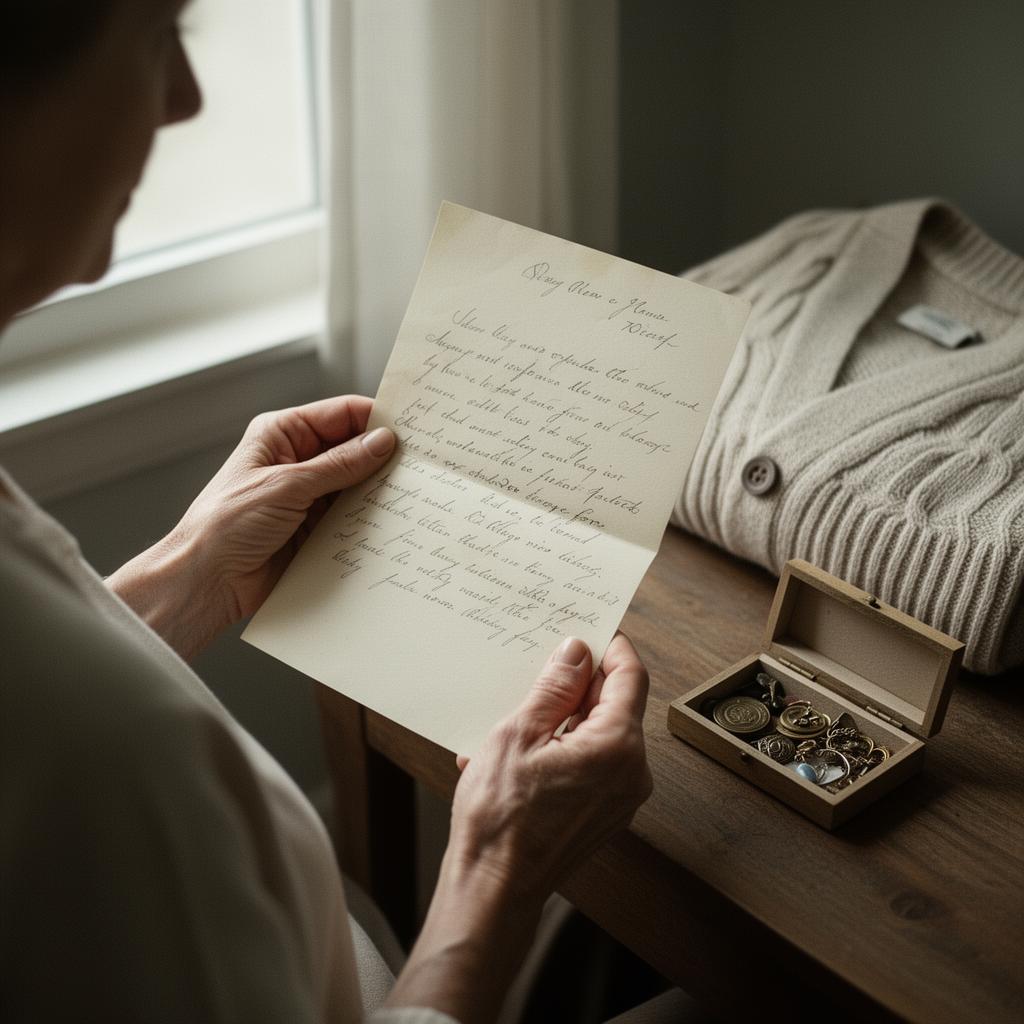
Most families experience the same three-wave pattern during sorting.
The first wave (weeks 1–3): numbness. You move efficiently. You feel guilty for feeling efficient. Decisions come easily and you question yourself for it.
The second wave (weeks 3–8): the walls come down. You open a drawer and find a card your mother wrote to your father in 1978 and the floor drops out. Decisions become impossible. You start keeping things you would have released a month earlier.
The third wave (weeks 8–16): equilibrium. The grief becomes part of the sorting instead of interrupting it. You can hold the card and decide about the drawer at the same time.
If you are in wave two and feeling unable to continue, you are not failing. You are at the hardest part. Most people need 2–4 months to get through wave two. Some need longer. Pausing during wave two is not giving up — it's often the most important decision you'll make in the entire process.
If the grief feels larger than the sorting — if daily function is affected, if you can't sleep, if the sadness is not shifting over weeks — please consider talking to someone. The emotional weight of sorting a parent's home is one of the highest-intensity grief experiences most adults ever have.
If you'd like to speak with a licensed grief counselor, we've reviewed the best online options on our Best Grief Counseling Online page.
When you're ready to release the rest
At some point — often in wave three — most families reach a point where the sentimental sorting is done and what's left is simply "stuff we have decided to let go." That's the right moment to bring in help.
Three paths for the release phase, depending on what you have:
If you have mostly trash, worn furniture, and no-one-wants-it items:
You want junk removal. Straight hauling, typically $400–$1,800 for a standard home. Fast. See our guide to junk removal after death →
If you have a mix of donations, valuables, and things needing sorting help:
You want a full estate cleanout service. Sorting, donation routing, sometimes estate sales. Typically $1,500–$5,000. See our guide to estate cleanout services →
If the home has significant contents you'd like to sell:
You want an estate sale company. They price, market, and run the sale. Takes 30–40% commission. See our guide to estate sale companies →
Want to see options in your area?
Angi will match you with up to 3 vetted local professionals for whichever path you choose. Quotes are free, no obligation. Most families compare three before deciding — the price spread is usually 25–40%.
Get Free Quotes on Angi →Free · No obligation · Local pros only · Ad
Frequently asked questions
Data and guidance on this page informed by:
- • National Association of Productivity & Organizing Professionals
- • Institute for Challenging Disorganization
- • American Psychological Association — Grief and Bereavement
- • National Alliance for Grieving Children
- • Consolidated interviews with 3 licensed grief counselors and 2 estate attorneys (April 2026)
If the grief is larger than the sorting.
Sorting a loved one's belongings is one of the highest-intensity grief experiences most adults ever have. If it's becoming more than you can carry, licensed online grief counselors are an option many families find helpful — without waiting lists or the drive to an office.
See Grief Counseling Options →Don't leave this for your own family.
A paid-up final expense plan can cover the costs most families never plan for — including sorting, cleanout, and final arrangements.
Call 1-855-321-3094Ad · Licensed agents · No obligation
You May Also Find Helpful:
How to Clean Out a Deceased Person's House
A room-by-room practical walkthrough for families doing the physical work themselves — complementary to this belongings guide.
Read →Dividing Deceased Parents' Belongings Among Siblings
When the family has more than one adult child, distribution becomes its own challenge. Our deeper guide on sibling conversations and contested items.
Read →Estate Cleanout Services Near Me
When you're ready for professional help with the release phase, a comparison of the top 5 estate cleanout companies in the U.S.
Read →