Prescription medications in a deceased loved one's home need to be disposed of legally, safely, and promptly — especially controlled substances like opioids, sedatives, and stimulants. This guide follows current FDA, DEA, and EPA guidance.
Why this matters, briefly.
A typical American over 65 takes 5 or more prescription medications. When someone dies, those medications remain in the home — often opioids, benzodiazepines, sleep aids, blood pressure drugs, and over-the-counter medicines mixed together in medicine cabinets, bedside drawers, and kitchen counters.
Three reasons to handle this promptly and correctly:
- Safety. Unused prescription opioids in the home are the single largest source of opioid misuse among teens and young adults — 53% of misused opioids come from a friend or family member, most often from a medicine cabinet. Clearing the medicine cabinet is a safety measure for anyone visiting the home.
- Legal compliance. Controlled substances (Schedule II–V drugs including opioids, benzos, stimulants) have specific legal disposal requirements. You cannot mail them, give them to another person, or sell them. Getting this wrong is technically a federal offense — even if the person they belonged to has died.
- Environmental. Flushing medications contributes to pharmaceutical contamination of water supplies. The FDA and EPA both recommend against flushing for nearly all medications — with a narrow exception list covered below.
The Disposal Decision Hierarchy
There are four disposal methods, ranked by preference per current FDA and EPA guidance. Always use the highest-preference option that's available to you.
Drug Take-Back Programs
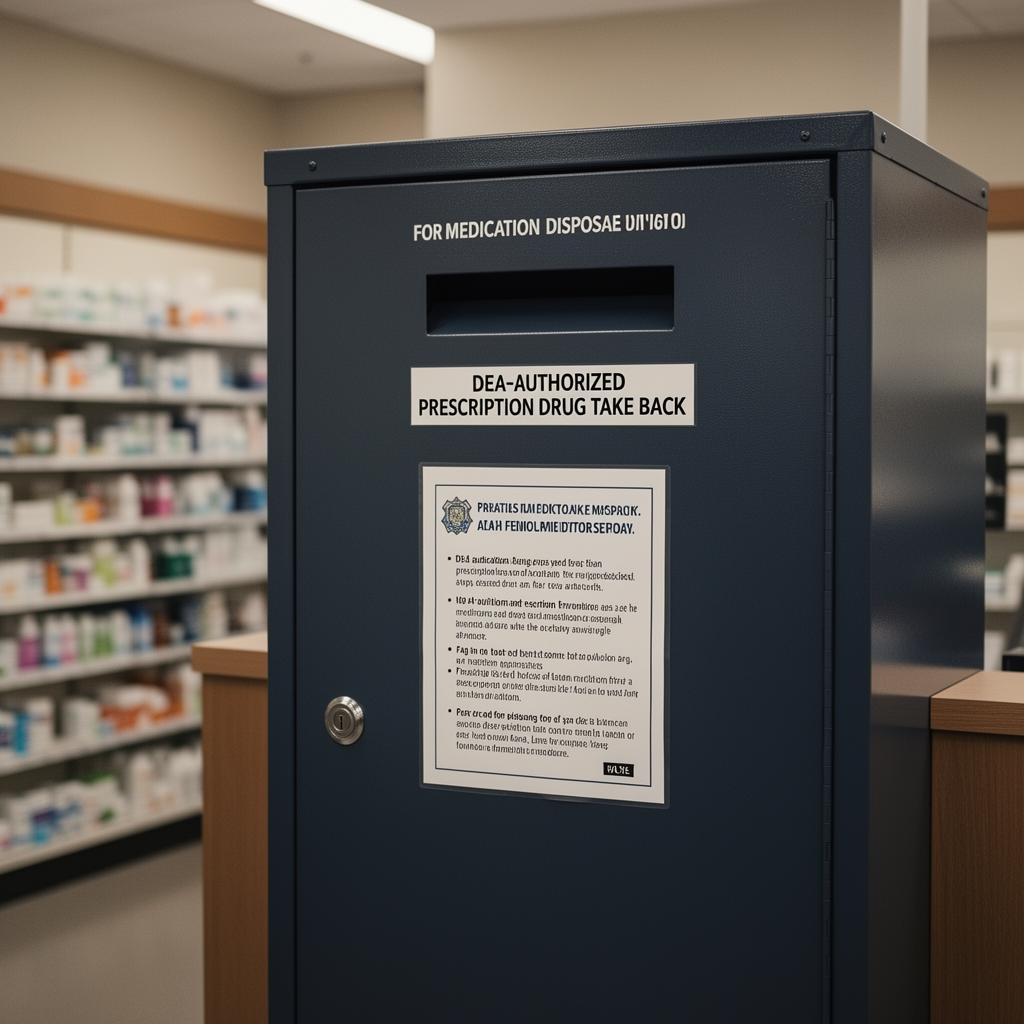
Preferred method for all medications, including controlled substances, patches, and over-the-counter drugs.
Where to find one:
- DEA's year-round locator: takebackday.dea.gov — search by ZIP code for over 16,500 year-round disposal locations including pharmacies, hospitals, police stations, and DEA-authorized collectors.
- National Prescription Drug Take Back Day: Held twice yearly (spring and fall). The most recent event was April 25, 2026. The next will be late October 2026. Free, anonymous, no questions asked. dea.gov/takebackday
- Walmart, CVS, Walgreens: Most locations now host year-round drop boxes or offer disposal kits. Call ahead to confirm the individual location participates.
- Local police departments: Many maintain permanent drop boxes 24/7. Call the non-emergency number.
What they accept:
Tablets, capsules, patches (fentanyl, nicotine), most liquid medications in original sealed containers, pet medications, vaping devices with batteries removed, controlled substances (Schedule II–V).
What they typically don't accept:
Needles/sharps/syringes, pressurized inhalers (asthma, COPD), illegal drugs, large volumes of liquid, lithium-ion batteries.
Mail-Back Envelopes
Pre-paid, postage-included envelopes for mailing medications directly to authorized disposal facilities.
Where to get them:
- Free from some pharmacies (ask the pharmacist)
- Available for purchase from commercial services like Inmar, TakeAway Environmental Return System, or Sharps Compliance — typically $5–$15 per envelope
- Some insurance plans and Medicare Advantage plans cover mail-back envelopes at no cost
Best for: Rural families who can't reach a take-back location, families handling small-to-moderate quantities, elderly executors who can't drive.
Legal note: Mail-back envelopes are legal for controlled substances — they are DEA-authorized and the only legal way to "ship" controlled drugs. Do NOT put controlled substances in a regular USPS envelope.
The FDA Flush List
Flushing is ONLY appropriate when:
- The medication is on the FDA's Flush List (approximately 15 high-risk medications, mostly opioids and fentanyl patches), AND
- A take-back option is not readily available, AND
- Your local regulations permit flushing
What's on the Flush List:
The list is narrow and specific. Check the current list at fda.gov/drugs/disposal-unused-medicines/drug-disposal-fdas-flush-list. It includes:
- Fentanyl patches (Duragesic and equivalents) — even after use, patches retain enough fentanyl to kill a child or pet
- Oxycodone (OxyContin, Percocet in some formulations)
- Hydrocodone combination products (Vicodin, Norco in certain formulations)
- Morphine (MS Contin and others)
- Buprenorphine (Suboxone, Butrans)
- Methadone
- Diazepam rectal gel (Diastat)
- Sodium oxybate (Xyrem)
- A small number of additional opioids and potent medications
If a medication is NOT on the list, do NOT flush it. Use Tier 4 instead.
Environmental note: The FDA has concluded that the risk to children and pets from accidentally accessing flush-list medications in trash outweighs the environmental risk of flushing. The EPA strongly prefers take-back even for flush-list medications when a take-back option is available.
Household Trash With Modification
For non-flush-list medications when take-back and mail-back aren't available.
The FDA-recommended procedure:
- Remove the medication from its original container (this prevents identification by anyone who might retrieve it from the trash)
- Mix the medication — pills, capsules, or liquids — with an unappealing substance such as dirt, cat litter, or used coffee grounds. Do NOT crush tablets or capsules. Crushing increases inhalation risk for both you and waste handlers.
- Place the mixture in a sealed container (ziploc bag, empty yogurt container, or similar)
- Throw the sealed container in your household trash
- On the empty pill bottle: scratch out or black out the patient's name, prescription number, and any identifying information before recycling or trashing
What cannot use this method: Any flush-list medication, any controlled substance (Schedule II–V). These require take-back or mail-back only — they cannot legally go in household trash, even modified.
Special Cases — Specific Medications and Forms
Several medication types have specific handling requirements that fall outside the standard hierarchy above.
Controlled substances (Schedule II–V)
Controlled substances include opioids (oxycodone, hydrocodone, morphine, fentanyl, codeine), benzodiazepines (Xanax, Ativan, Klonopin, Valium), stimulants (Adderall, Ritalin, Vyvanse), and some sleep aids (Ambien). These are the medications most likely to cause legal issues if disposed of incorrectly.
Rules:
- Must be disposed of via a DEA-authorized take-back location or mail-back envelope. Household trash is not permitted.
- If the drug is on the FDA flush list AND take-back is unavailable, flushing is permitted as a last resort.
- Giving remaining controlled substances to another family member — even one with a legitimate prescription for the same drug — is illegal.
- Selling them is a federal crime.
What the executor should do: Locate all controlled substances before starting the general sort. Collect them in a single lockbox or secure bag. Take them to a DEA-authorized collector (pharmacy, hospital, police station) within 30 days of the death if possible. Do not leave controlled substances unsecured in the home during the sorting period — they are the highest theft risk.
Fentanyl patches (including used ones)
Fentanyl transdermal patches (Duragesic brand and generics) are the single most dangerous residential medication to dispose of incorrectly. Used patches retain enough fentanyl to kill a child, pet, or adult who chews or licks the adhesive side.
Disposal:
- Preferred: Take-back program. Patches are accepted at all DEA-authorized locations.
- Acceptable: Flush immediately — fentanyl patches are explicitly on the FDA Flush List specifically because of the residential risk.
- Never: Trash disposal, even modified. Used or unused patches in trash have killed children and pets in documented cases.
How to flush a patch: Fold the patch in half so the adhesive sides stick together, then flush. Used patches go in the toilet immediately after removal — do not set them on counters or bedside tables.
Inhalers (asthma, COPD, rescue inhalers)
Pressurized metered-dose inhalers cannot be thrown in regular trash — the canister can explode if compacted or incinerated.
Disposal:
- Most local hazardous waste collection programs accept inhalers
- Some manufacturer programs accept inhalers for recycling (Boehringer Ingelheim's Respimat inhalers, Teva's inhalers in some regions)
- Contact your local waste management authority or pharmacy for specific local guidance
- Do NOT take inhalers to standard DEA take-back locations — most do not accept them
Needles, syringes, and sharps
Sharps are biohazardous medical waste and follow different rules from pharmaceuticals.
Disposal:
- FDA-approved sharps container (available at pharmacies for $3–$10)
- Household sharps program: many cities run free drop-off points at fire stations or health clinics
- Commercial mail-back sharps disposal: $30–$60 per small container through services like Stericycle
- As a last resort, a thick plastic laundry detergent bottle (labeled "household sharps — do not recycle") is acceptable per FDA guidance in most states
Never put loose needles in regular trash or recycling. This is both illegal in most states and dangerous for waste handlers.
Liquid medications
Liquid prescriptions (cough syrups, antibiotic suspensions, oral morphine solutions) are accepted at most take-back programs in their original, sealed containers. If the container has been opened and partially used, check with the specific location — rules vary.
If take-back isn't available:
- Non-controlled liquids: absorb into cat litter or coffee grounds, seal in a plastic bag, dispose in household trash
- Controlled liquids: mail-back envelope only, do not trash
Over-the-counter medications
OTC medications (Advil, Tylenol, antacids, cold medicine, vitamins, supplements) follow the same hierarchy but with less urgency. Take-back preferred, household trash with modification acceptable, do not flush.
Vitamins and supplements expired more than 2 years ago often lose potency but are rarely dangerous — still dispose of rather than keep "just in case."
Expired prescriptions for other people
If you find medications in the deceased's home that were prescribed to other people — a spouse who predeceased them, a child who no longer lives there — treat them the same as the deceased's medications. The prescription follows the original patient legally. Since you are not that patient, you cannot dispense the medication to anyone, even the person it was originally prescribed to if they are still alive. Dispose using the hierarchy above.
Before You Dispose — Check These First
Three quick checks before disposing of any medication found in the home:
1. Is it still needed for an estate claim? Long-term care insurance claims, disability claims, and Medicare/Medicaid reviews sometimes require documentation of what medications were being taken at the time of death. Photograph all medication bottles before disposal — label, dosage, prescription number, pharmacy, expiration date. Keep the photos with estate paperwork.
2. Is the deceased in a medical study or research program? Some clinical trials require unused medication to be returned to the study site. Check with the primary care physician or any specialist the deceased was seeing.
3. Is the pharmacy record useful for anyone else in the family? The deceased's pharmacy record can help surviving family members identify hereditary conditions and understand family medical history. Before disposal, consider requesting a 12-month medication history from the pharmacy. Most pharmacies will provide this to the executor for free.
What Not to Do
- 1Do not give medications to another family member, even if they have the same prescription or a similar condition. It is illegal in most cases and medically risky — dosages and formulations change.
- 2Do not sell or donate medications. Selling controlled substances is a federal crime. Donating prescription medications to domestic charities is also illegal in most cases. A small number of international programs accept prescription medication donations (mostly for developing-country pharmacies), but these have strict rules and most family medications don't qualify.
- 3Do not keep medications "just in case." Storing controlled substances beyond the patient's death is technically illegal and creates theft and misuse risk. The executor has a reasonable period (typically 30–60 days) to dispose of medications — longer than that invites risk.
- 4Do not flush anything that is not on the FDA flush list. This includes common medications like statins, blood pressure medications, diabetes medications, antidepressants, and most antibiotics. Flushing these contributes to water supply contamination and is explicitly advised against by both FDA and EPA.
- 5Do not put pills in trash without modification. Loose pills in trash can be recovered by people going through trash, accessed by children, eaten by pets or wildlife, and ingested by waste workers. The mix-and-seal procedure is not optional.
- 6Do not dispose of high-value specialty medications before probate is open if those medications have significant resale value (some expensive specialty medications run $1,000+ per month). These are technically estate property. For most routine medications this doesn't apply, but for oncology or biologic drugs worth $500+, consult the estate attorney first.
Frequently Asked Questions
Information on this page is drawn from current guidance at:
- U.S. Food and Drug Administration (FDA) — Disposal of Unused Medicines
- U.S. Drug Enforcement Administration (DEA) — Diversion Control Division
- U.S. Environmental Protection Agency (EPA) — Household Medication Disposal
- National Institute on Drug Abuse (NIDA)
- Substance Abuse and Mental Health Services Administration (SAMHSA)
- American Society of Health-System Pharmacists
Guidance verified against April 2026 agency publications.
You May Also Find Helpful:
How to Sort Through a Deceased Loved One's Belongings
The room-by-room physical workflow for sorting an entire home — including how to handle paperwork, photos, and valuables during the sort.
Read →What to Do With a Deceased Loved One's Belongings
The strategic decision framework — what to keep, what to release, how to handle sibling disagreements before they escalate.
Read →How to Clean Out a Deceased Person's House
Room-by-room practical guide for families handling a full home cleanout, with or without professional help.
Read →